What Peter Attia Got Right (And What's Still Missing)

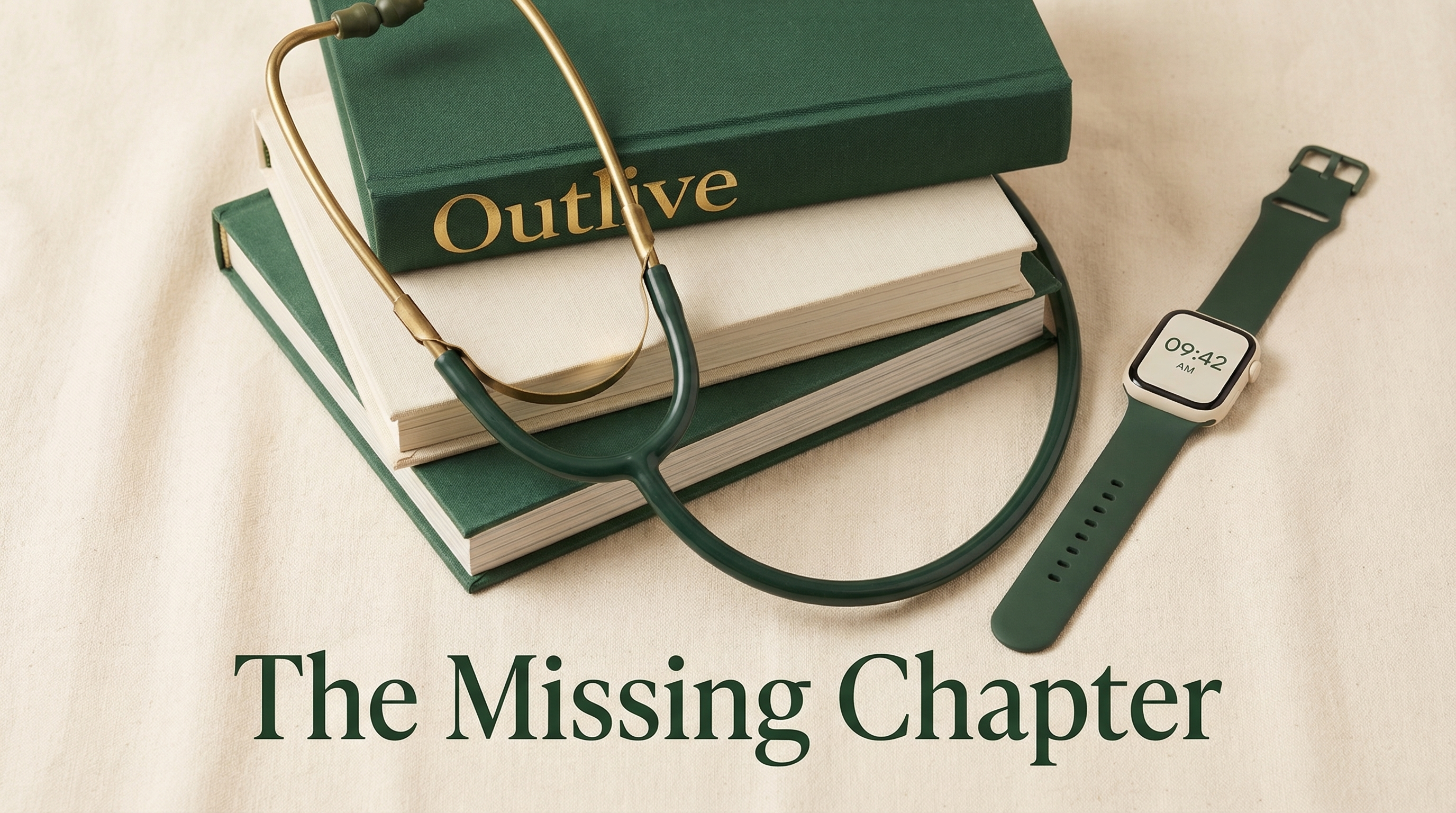
I've read Outlive twice. It's the best popular-science book on longevity that exists, and Peter Attia is one of the most rigorous thinkers in medicine. The framework he lays out (Exercise with Zone 2, VO2 max, and strength; Nutrition; Sleep; and Emotional Health) is almost exactly right.
Try this technique in Vayu, free download
Haptic guidance on Apple Watch and Wear OS. Your first session is free.
Almost.
The chapter I kept coming back to was Chapter 17: "Work in Progress: Emotional Health." Attia is characteristically honest about it: he calls it the most important pillar and the one he struggles with most personally. He talks about therapy, about his own demons, about the cost of chronic stress on longevity outcomes.
But the prescription is thin. And I think I know why.
What Attia Gets Completely Right
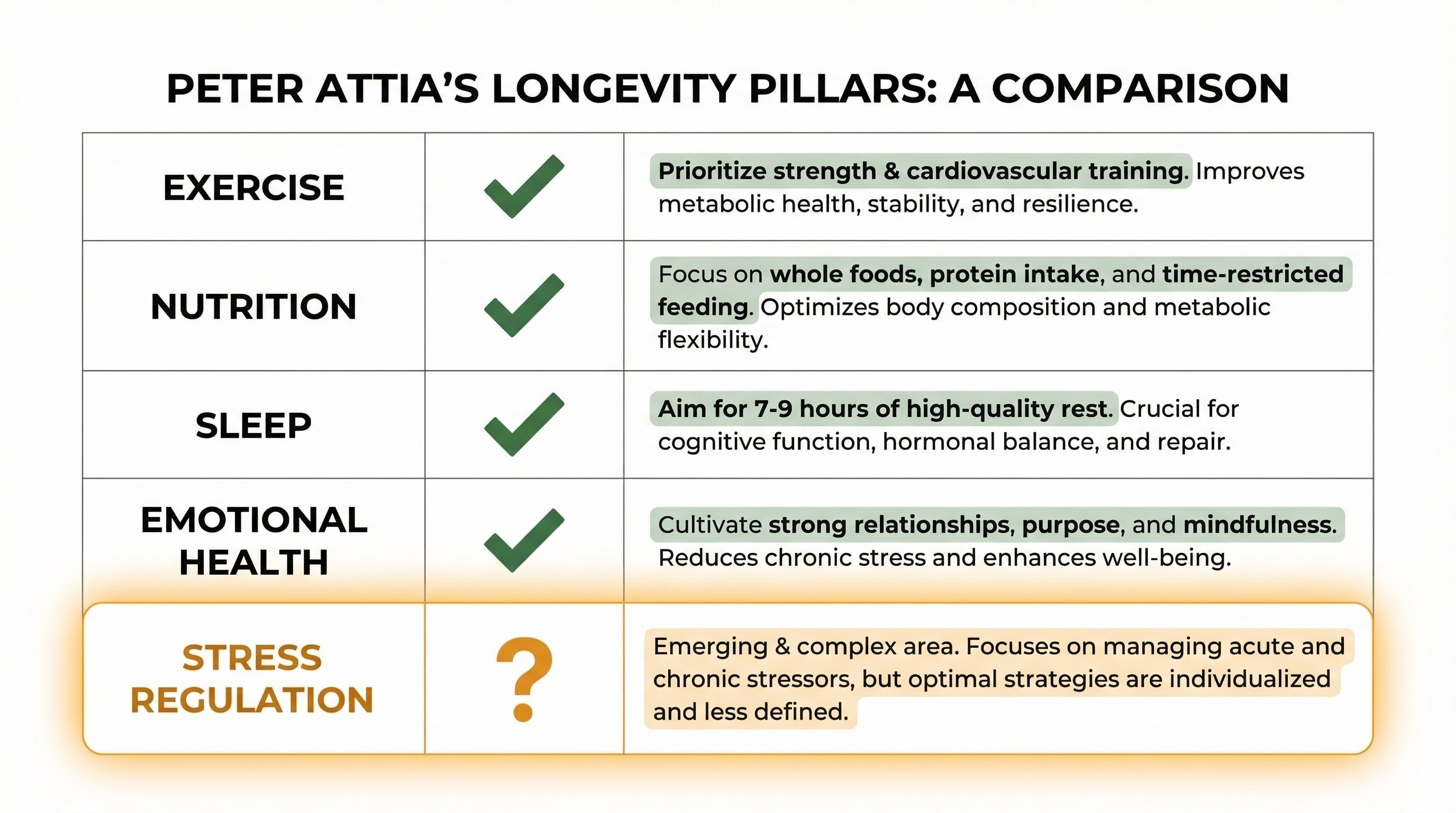
Let's start with what's undeniably correct. Attia's case for Zone 2 cardio as the foundation of metabolic health is bulletproof. The evidence for VO2 max as the single strongest predictor of all-cause mortality is compelling. His argument for preserving muscle mass and strength through resistance training well into old age is well-supported and underappreciated by mainstream medicine.
The sleep chapter is excellent. Attia correctly identifies sleep as the one non-negotiable lever in the longevity equation. You can't hack your way out of insufficient sleep, and the metabolic consequences of chronic sleep deprivation are severe.
His framing of Medicine 3.0 (proactive, personalized, evidence-based intervention before disease arrives) is exactly right and long overdue. The annual physical as currently practiced is a theatrical exercise in false reassurance.
All of this lands. Hard.
The Stress Regulation Chapter Is Thin
Here's where I think the framework has a gap. Attia's emotional health pillar is largely addressed through therapy, boundary-setting, and behavioral work. These are legitimate and important. But they operate on timescales of months and years. They don't address what happens in the 90 seconds after you open an email that makes your cortisol spike.
The physiological reality is this: chronic stress is a moment-by-moment accumulation of acute stress responses that never fully resolve. Each unresolved cortisol cascade leaves a residue. Your HRV baseline drops a little. Your sleep quality degrades a little. Your insulin sensitivity erodes a little. Over years, this compounds into exactly the disease burden Attia is trying to prevent.
Therapy helps you understand the patterns. It doesn't stop the cortisol cascade in real time.
There is a tool that does. And it barely appears in Outlive.
Real-Time ANS Intervention: The Missing Chapter
Breathwork (specifically, slow diaphragmatic breathing with an extended exhale) is the only evidence-based tool that modulates the autonomic nervous system in real time. The mechanism runs through the vagus nerve: extended exhalation directly activates the parasympathetic branch, increasing HRV and suppressing cortisol within minutes of practice.
The research is not fringe. A 2018 systematic review in Frontiers in Human Neuroscience (Zaccaro et al.) documented consistent HRV increases, cortisol reductions, and improved emotional regulation across 15 studies of slow breathing techniques. HRV biofeedback has a robust evidence base for reducing hypertension, anxiety disorders, PTSD, and depression, without pharmacological intervention.
This is exactly the kind of evidence-based, proactive intervention that Medicine 3.0 demands. But Attia's framework (focused on Zone 2, strength, sleep, and therapy) doesn't include a real-time stress modulation protocol. It's the one pillar that still lacks a practical tool.
Where Vayu Fits
I'm not here to criticize Outlive. It's a gift to everyone who reads it. What I'm saying is that the framework isn't complete until you address the moment-by-moment regulation of the autonomic nervous system, not just the structural factors that influence it over time.
Vayu is that missing piece. HRV read from your Apple Watch after each session, shaping the next one. Haptic-guided breathwork that activates the vagus nerve on demand. A feedback loop that shows you your nervous system responding session by session.
Zone 2 builds your aerobic base. Breathwork tunes the operating system that runs on top of it.
If you've read Outlive and you're implementing Attia's framework seriously, Vayu belongs in your stack. Not instead of the other pillars. Alongside them.
Download Vayu, the real-time ANS intervention that completes the Medicine 3.0 framework.
Practice These Techniques with Vayu
Haptic breathing guidance on Apple Watch and Wear OS, paced on your wrist so you do not need the screen. Developed with the SFU Metacreation Lab, supported by NRC IRAP. Your first session is free.
Continue Reading
Why Your Workplace Needs to Breathe: The Case for Autonomic-Aware Enterprise Wellness
Corporate wellness is an $80B industry that isn't working. The missing layer: real-time nervous system support through micro-interventions that fit into a workday.
Mar 3, 2026

The 90-Second Window: Why Stress Intervention Has to Be Real-Time or It's Useless
There is a 90-second window after stress onset when breath can interrupt a cortisol cascade. After that window closes, you're managing damage, not preventing it. Here's the neuroscience, and why real-time intervention is the only kind that matters.
Mar 22, 2026

What’s Wrong With Breathing Today—and What “Right Breathing” Actually Means
We breathe 20,000 times daily—yet most of us do it wrong. Learn what right breathing means, the science of pranayama, and two exercises to try today.
Jan 21, 2026