Pranayama vs Breathwork: What's the Difference?
By Deepali Raiththa, Chief Design Officer & Co-Founder, Prana Labs
Try this technique in Vayu, free download
Haptic guidance on Apple Watch and Wear OS. Your first session is free.
People use "pranayama" and "breathwork" as if they are the same thing. They aren't, quite. Pranayama is a specific, several-thousand-year-old discipline from yoga, with named techniques and a clear intention behind each one. Breathwork is the modern umbrella term that covers pranayama plus a lot of newer methods, from Wim Hof to holotropic sessions to the box breathing a Navy diver runs before going under. Same raw material, your breath, but different lineages and different goals. Here is how to tell them apart, and why it changes what you should actually practice.
The short version
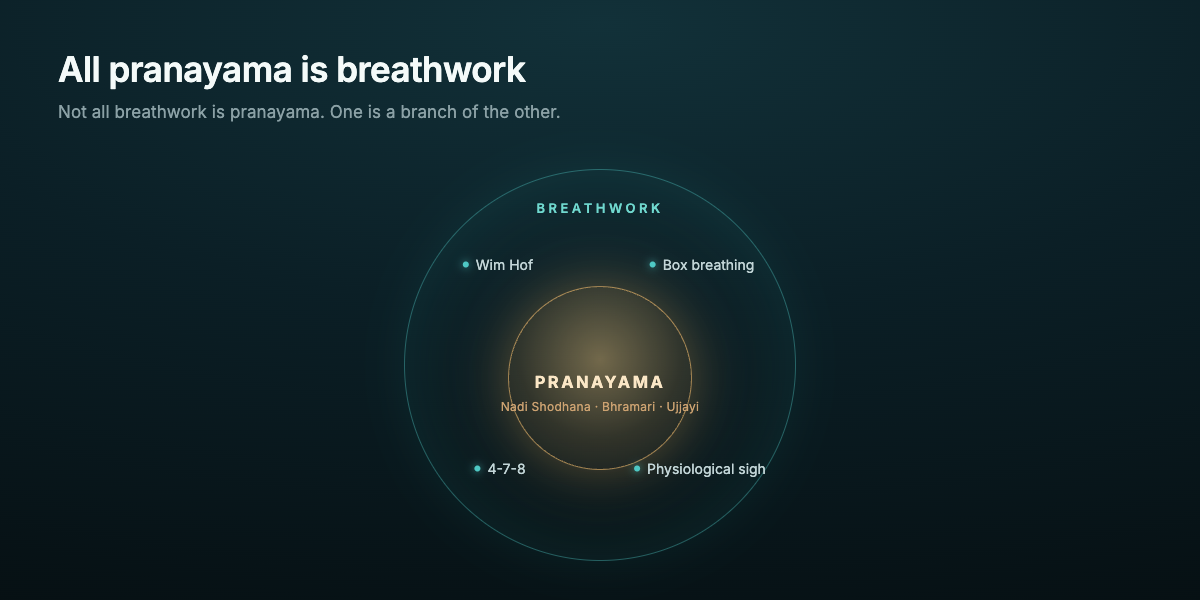
Pranayama is a branch of breathwork. All pranayama is breathwork; not all breathwork is pranayama.
If you want a one-line test: pranayama comes with a tradition attached. It has a source text, a named technique, a prescribed rhythm, and an intention about where it should take your mind. Most modern breathwork keeps the technique and drops the tradition. That is fine. It just changes what you are doing and why.
What pranayama actually is
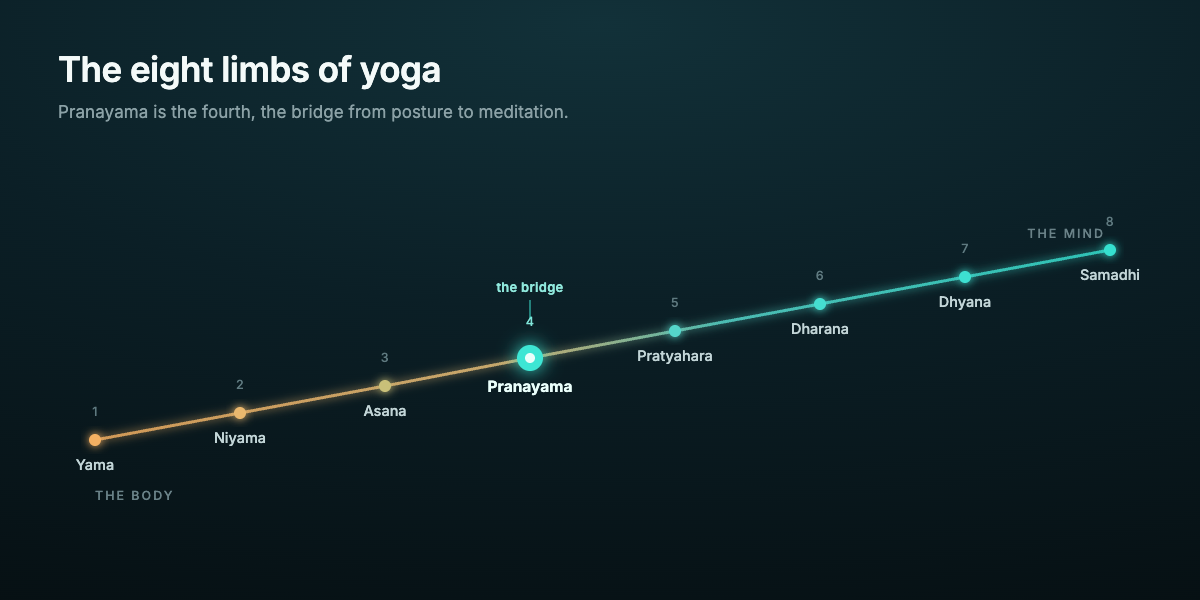
Pranayama is the fourth of the eight limbs of yoga described in Patanjali's Yoga Sutras, dated to roughly 200 BCE. The word joins prana (life force, breath) with ayama (to extend or regulate). It sits between the physical postures (asana) and the inward turn of attention (pratyahara), which tells you what it was built for: a bridge from body to mind.
What makes something pranayama rather than just "breathing well" is specificity. Each technique has a name, a method, and a purpose:
- Nadi Shodhana (alternate nostril breathing) steadies and balances the mind.
- Kapalabhati (skull-shining breath) is a rapid, active exhale used to energize and clear.
- Bhramari (humming breath) uses vocal vibration to settle anxiety and hold focus.
- Ujjayi (victorious breath) is the soft ocean sound you keep through a movement practice to anchor attention.
These were not improvised. They were refined over centuries of close attention to internal states, and most of them carry an intention that matters as much as the mechanics. The breath is the way in, not the destination. If you want the deeper version of that story, we wrote about pranayama meeting modern science separately.
What breathwork means today
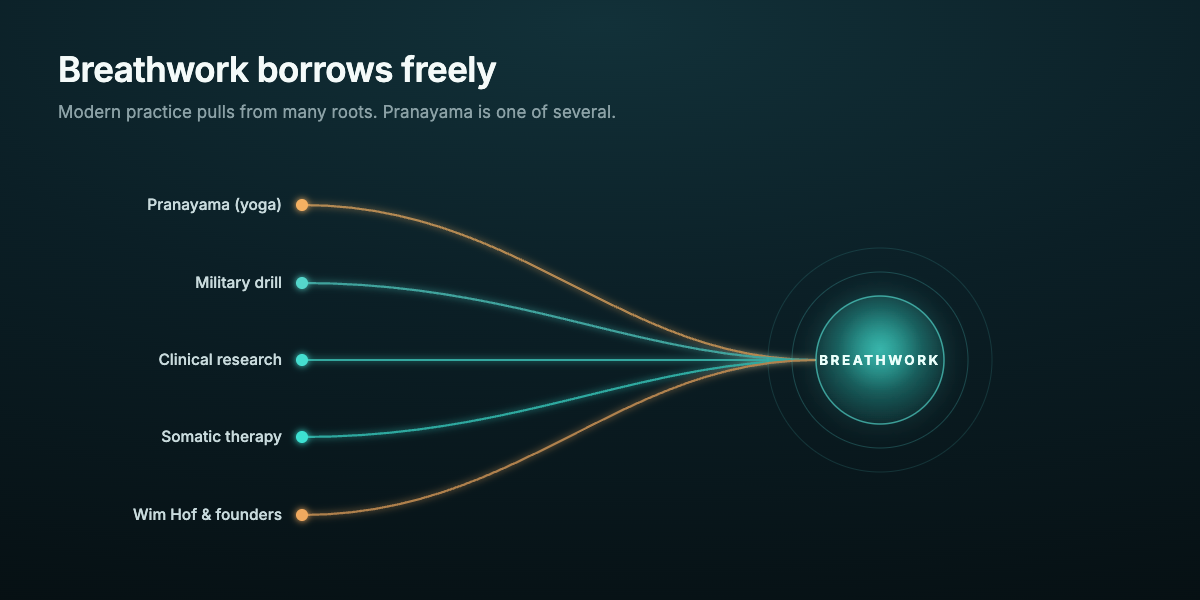
Breathwork is the broad, modern, mostly secular category. It borrows freely: from pranayama, from clinical research, from somatic therapy, and from a few well-known founders. Under the same tent you will find:
- Box breathing (4-4-4-4), popularized by the military for staying steady under pressure.
- 4-7-8 breathing, a relaxation pattern built around a long exhale.
- The Wim Hof Method, rounds of heavy breathing and breath holds that deliberately spike arousal.
- Holotropic and conscious-connected breathing, longer sessions aimed at emotional release and altered states.
- The physiological sigh, a double inhale and long exhale that is one of the fastest ways to calm down.
The center of gravity is different here. Modern breathwork tends to lead with an outcome, calmer or more awake or some kind of release, and stays agnostic about tradition. That is part of why it spread so fast. It also means the quality and the claims vary a lot from one method to the next.
The real differences
| Dimension | Pranayama | Modern breathwork |
|---|---|---|
| Origin | Yogic tradition, ~200 BCE onward | Mostly 20th and 21st century |
| Intention | Preparation for meditation, shifting state | Usually one specific outcome |
| Structure | Named techniques, set rhythms | Ranges from precise to freeform |
| Framing | Spiritual and philosophical | Mostly secular and physiological |
| Guidance | Traditionally teacher-led | Apps, videos, workshops, self-led |
None of this makes one better than the other. It tells you what you are signing up for.
Where they overlap: the physiology
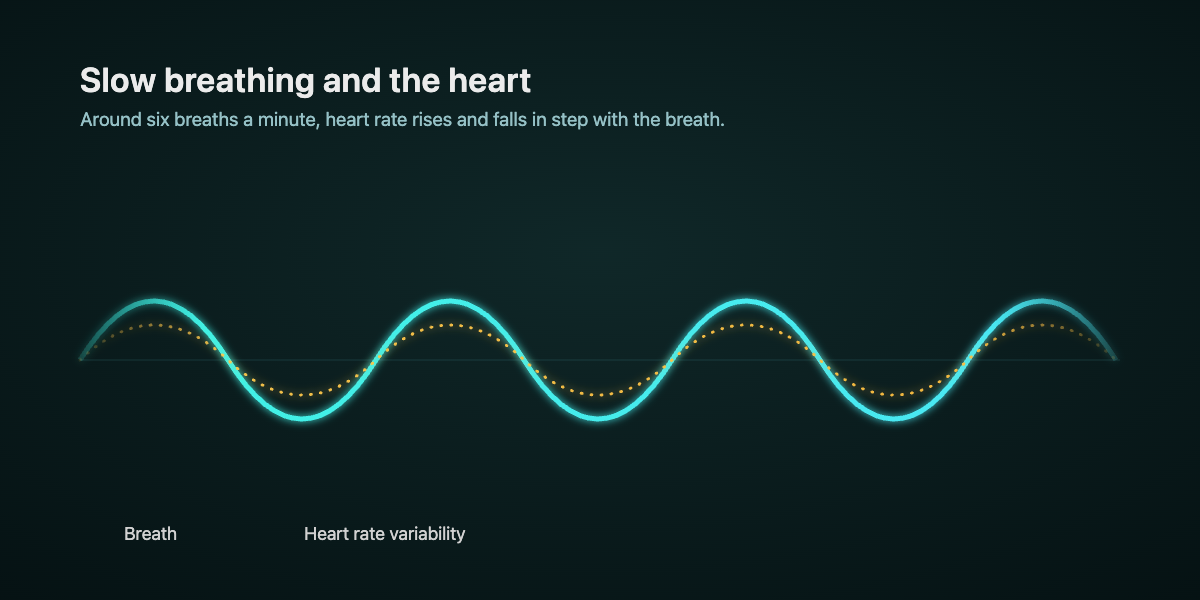
Here is the part that should make you take both seriously. When researchers measure what slow, deliberate breathing does to the body, the mechanisms line up whether you call it pranayama or breathwork.
A 2018 systematic review in Frontiers in Human Neuroscience by Andrea Zaccaro and colleagues pooled dozens of studies on slow breathing and found consistent effects: greater heart-rate variability, higher vagal (parasympathetic) tone, and self-reports of calm alertness. Paul Lehrer and Richard Gevirtz have shown that breathing near six breaths a minute, what they call resonance frequency, produces the largest and healthiest swings in heart rate. Pranayama practitioners have been breathing at roughly that rate for a very long time, without the instruments to give it a name. If you track your own HRV while you breathe, you can watch this happen.
The differences show up in the data too. A 2023 study from Melis Yilmaz Balban and colleagues at Stanford, published in Cell Reports Medicine, put several short breathwork practices head to head. A slow, exhale-emphasized pattern (cyclic sighing) improved mood and lowered arousal more than either mindfulness meditation or faster, more activating breathing. The specific technique matters, and the old yogic insistence on making the exhale longer than the inhale turns out to have a physiological basis.
Which should you practice?
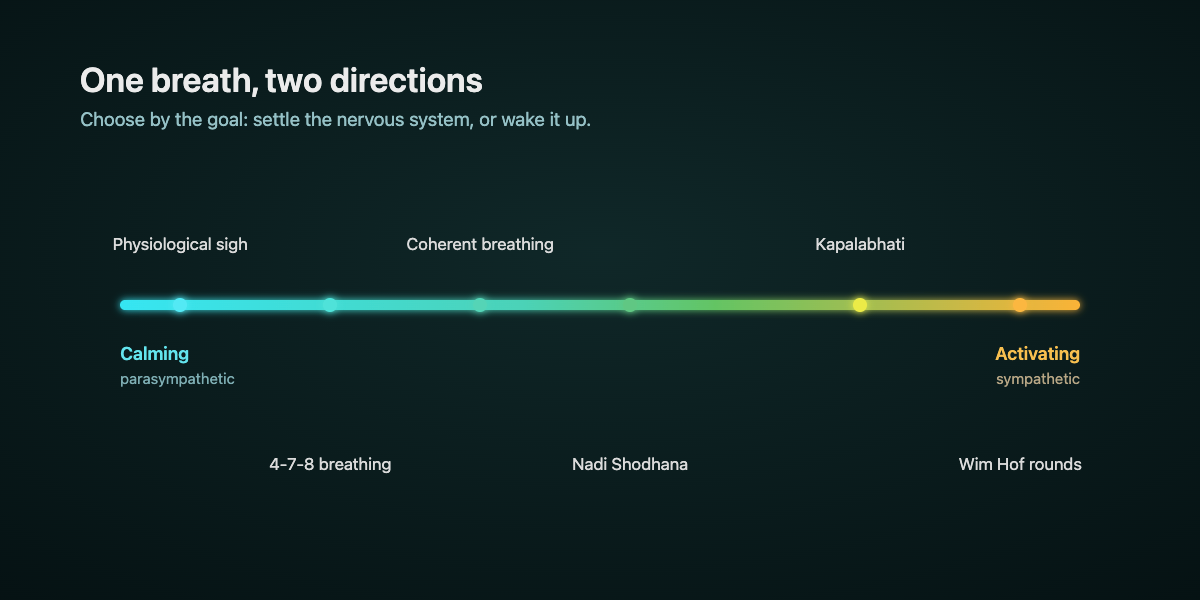
Start with the goal, not the label.
To wind down, sleep better, or settle your nervous system, reach for slow, exhale-led practices: coherent breathing, 4-7-8, Nadi Shodhana, the physiological sigh. Our guide to breathing for anxiety walks through the calming end of the spectrum. For energy or a sharp jolt of focus, the activating methods (Kapalabhati, Wim Hof rounds) do the job, with the honest caveat that they are not for everyone and are best learned with guidance. And if you want a practice with real depth and a long tradition to grow into, pranayama gives you somewhere to keep going for years.
You do not have to pick a camp. The useful thing is knowing which tool you are holding and what it is for.
How Vayu fits
We built Vayu to hold both ends of this. The techniques come from the tradition, taught with the intention intact rather than stripped down to a timer. The delivery is modern: guided sessions that adapt to you, on your phone and your watch, with your heart rate feeding back in real time so you can see the shift instead of guessing at it.
Ancient technique, honestly taught. Modern guidance you will actually use. If you are not sure where to start, a few minutes of guided Nadi Shodhana is a good first breath.
References
- Patanjali. Yoga Sutras (c. 200 BCE), on pranayama as the fourth limb of yoga.
- Zaccaro, A., et al. (2018). "How Breath-Control Can Change Your Life: A Systematic Review on Psycho-Physiological Correlates of Slow Breathing." Frontiers in Human Neuroscience.
- Lehrer, P. M., & Gevirtz, R. (2014). "Heart rate variability biofeedback: how and why does it work?" Frontiers in Psychology.
- Yilmaz Balban, M., et al. (2023). "Brief structured respiration practices enhance mood and reduce physiological arousal." Cell Reports Medicine.
Practice These Techniques with Vayu
Haptic breathing guidance on Apple Watch and Wear OS, paced on your wrist so you do not need the screen. Developed with the SFU Metacreation Lab, supported by NRC IRAP. Your first session is free.
Continue Reading
Breathwork Safety: Who Should Not Do Which Techniques
Breathwork is generally safe is true of slow techniques and not always true of fast ones. A clear map of which practices carry real risk, and for whom.
Sep 15, 2026
Medicine 2.0 Told Me I Was Sick. Medicine 3.0 Showed Me How to Fix It.
Dhruv was pre-diabetic at 28. Every wearable measured his decline. None of them told him how to reverse it. This is the origin story of Vayu, and the difference between Medicine 2.0 and Medicine 3.0.
Mar 22, 2026
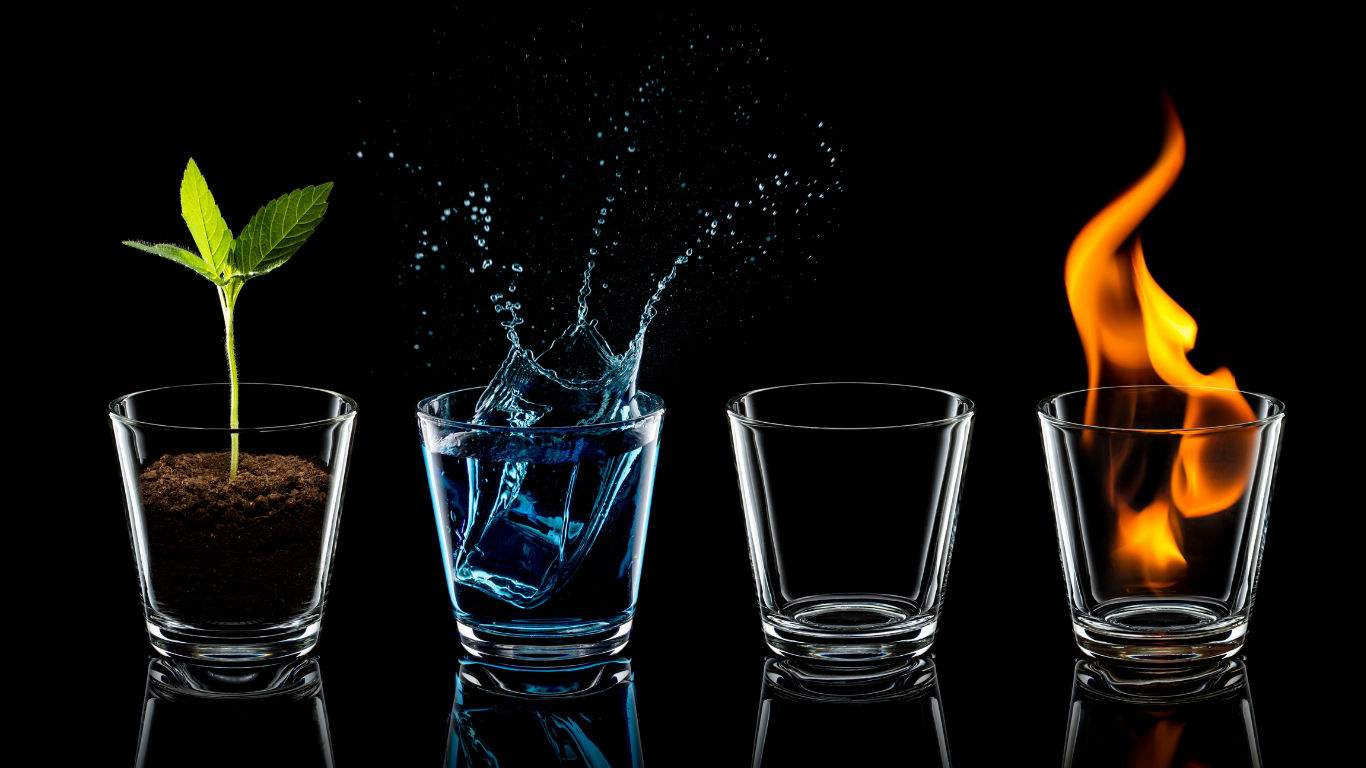
Doshas and Pranayam
Ayurveda, an ancient holistic healing system from India, identifies three primary bioenergetic forces—doshas—known as Vata (air and ether), Pitta (fire and water), and Kapha (earth and water). Each individual possesses a unique combination of these doshas, which govern physical, emotional, and mental characteristics (e.g., Vata types tend to be energetic and creative but may experience anxiety when imbalanced) healthline.comen.wikipedia.org. Understanding one’s dominant dosha (Prakriti) and current imbalances (Vikriti) is foundational to maintaining health through targeted diet, lifestyle, and yogic practices. In particular, pranayama (breathwork) techniques can be tailored to pacify excessive qualities of each dosha: slow, grounding breaths for Vata; cooling breaths for Pitta; and energizing, warming breaths for Kapha. Below, we explore the nature of each dosha, signs of imbalance, and detailed instructions for dosha-specific pranayama practices.
Jun 6, 2025