When the Doctor Said 'Diabetes,' He Said 'Give Me 90 Days': Dhruv Adhia on Peaceful Computing and the Future of Conscious AI
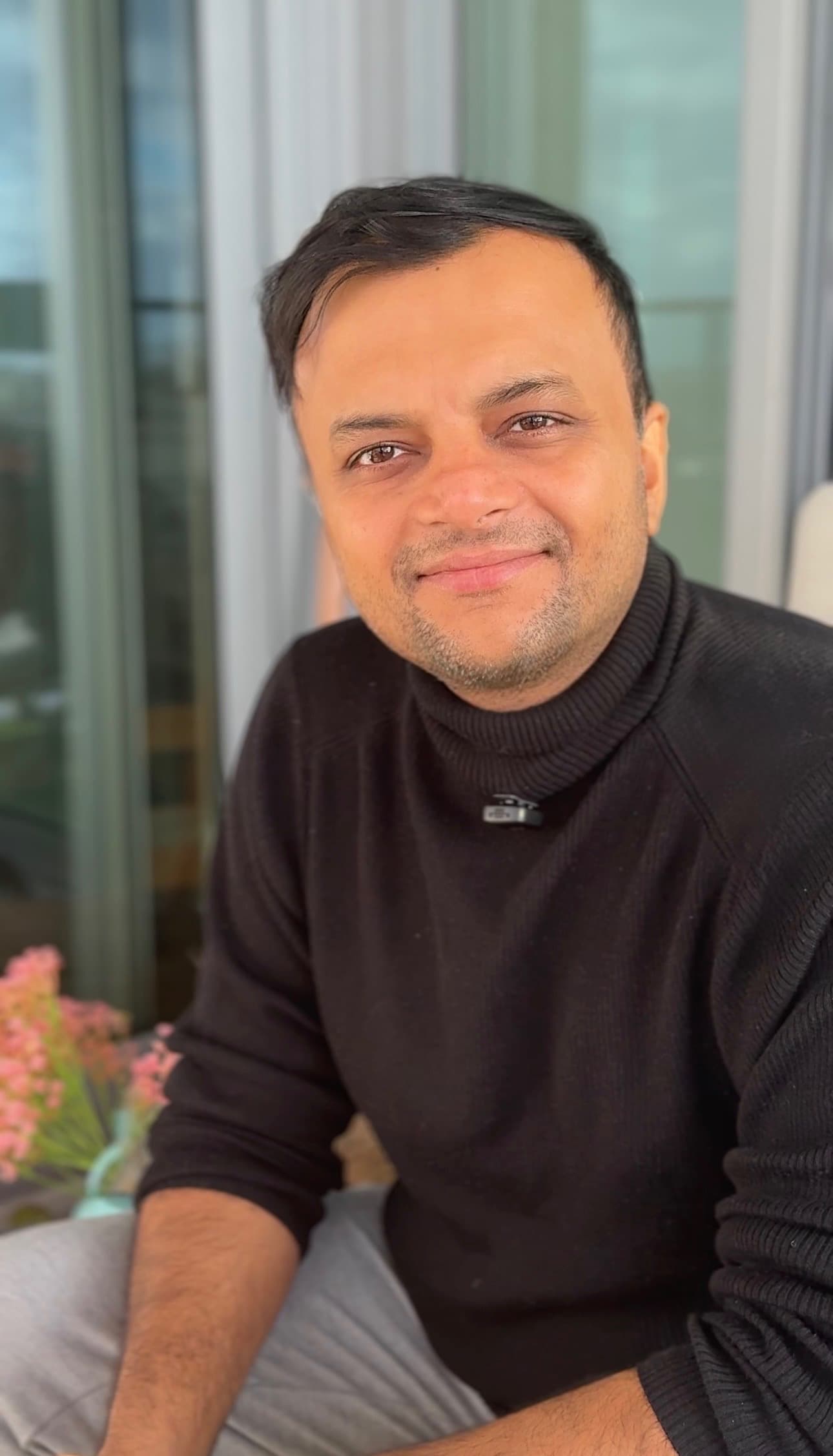
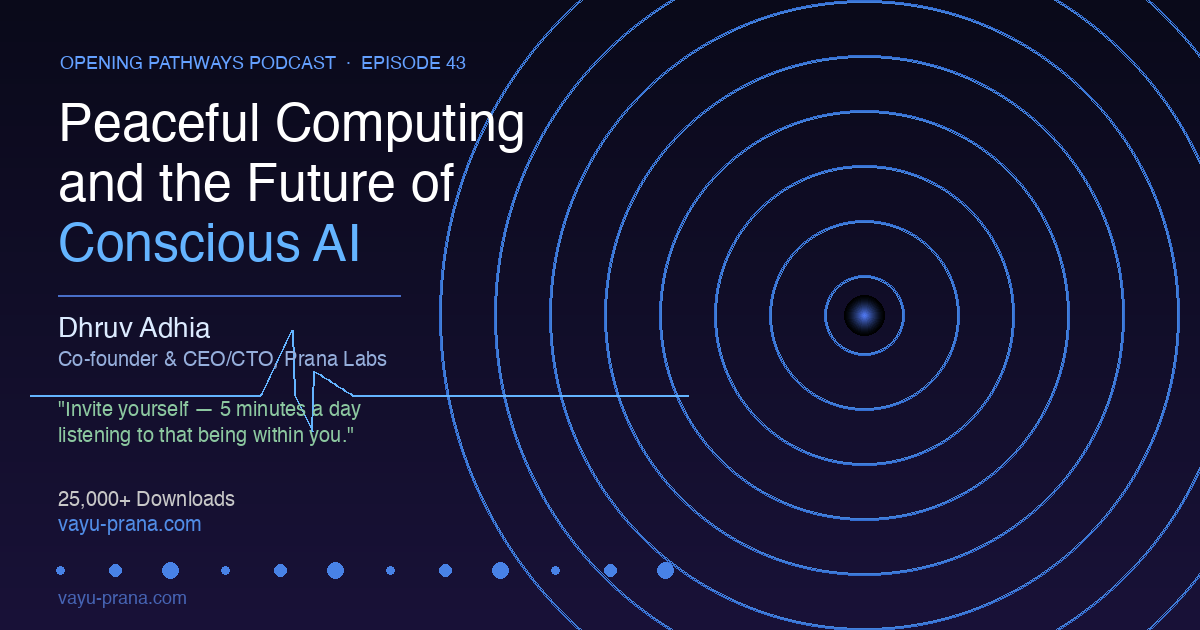
*From the Opening Pathways Podcast, SE02 E43, a conversation about burnout, breath, and building technology that actually serves humanity.* --- There's a moment in every entrepreneur's story where the body finally says *enough*. For Dhruv Adhia, that moment arrived on May 4th, 2019, sitting in a doctor's office, staring at a type 2 diabetes diagnosis. Years of relentless building, of pushing past limits that were never meant to be pushed, had quietly unraveled his health. The prescription pad came out. And in that moment, something in Dhruv shifted. "I told my doctor, 'Stop writing prescriptions. Give me three months.'" It's the kind of thing most people think but never say. Dhruv said it. And then he backed it up, losing 18 kilograms in 45 days, normalizing his A1C, reversing the diagnosis entirely through breath, movement, and a radical recommitment to how he lived. That experience didn't just change his body. It became the founding philosophy of everything he would build next. --- ## 🎙️ Watch the Full Conversation [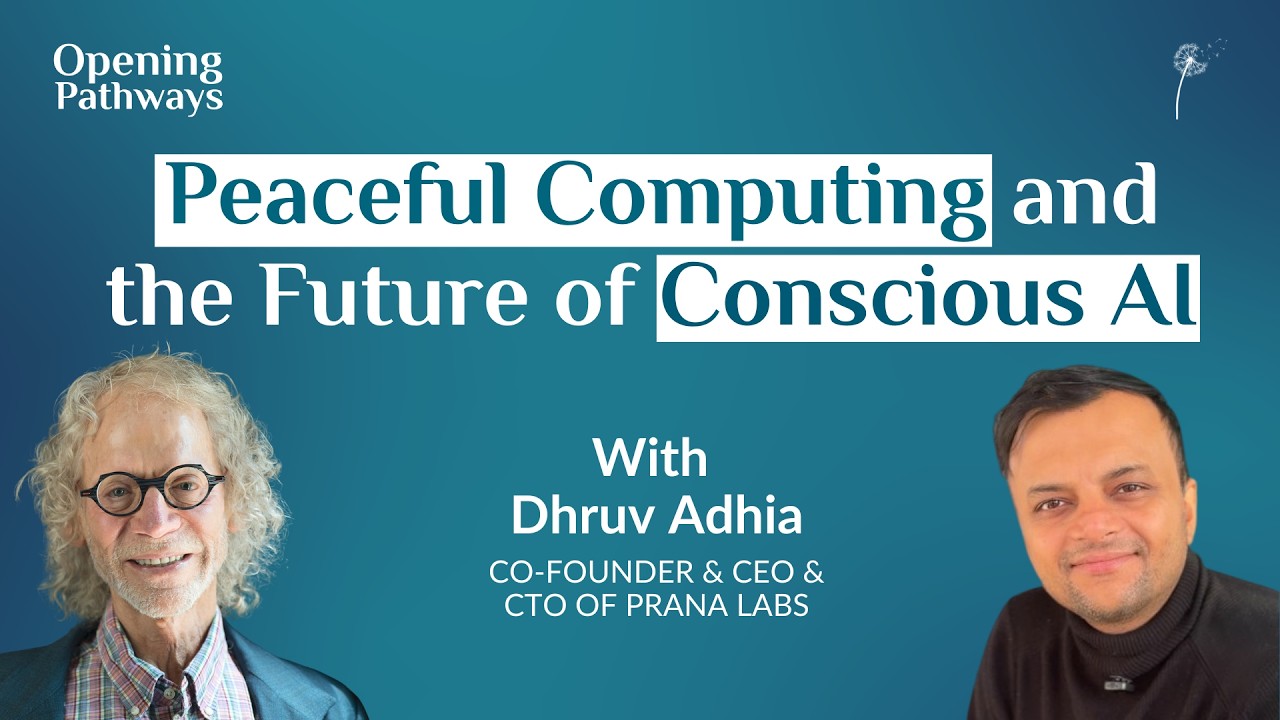](https://www.youtube.com/watch?v=dzIyrIXRozw) *Dhruv Adhia joins host Tom LeNoble on the Opening Pathways Podcast for a wide-ranging conversation on burnout, breath, and building technology with soul.* --- ## The Origin Story: A Crisis That Became a Calling Entrepreneurial burnout is rarely dramatic. It doesn't announce itself. It accumulates, in the late nights, the skipped meals, the cortisol that never fully clears, the quiet erosion of the things that once made life feel full. By 2019, Dhruv had been running hard for years. He was building things, growing things, solving problems. And somewhere in that relentless forward motion, he had stopped listening to himself. The diabetes diagnosis was the circuit breaker. What happened in the months that followed was less a wellness journey and more a philosophical awakening. Dhruv didn't just change his diet or add a workout routine. He went deeper, into breathwork, into mindfulness, into the ancient frameworks that had understood the mind-body connection long before modern medicine gave it a name. He found Maharshi Patanjali's Yoga Sutras, and one phrase in particular lodged itself in his thinking: *yoga chitta vritti nirodha*, yoga is the cessation of the activities of the mind. "The monkey brain reacts," he explains. "The conscious self responds. That gap, that pause, is where everything changes." It's a deceptively simple idea. And it became the seed of Prana Labs. --- ## What Is "Peaceful Computing", And Why Does It Matter? Here's a question worth sitting with: When was the last time your phone made you feel *calm*? Most of us would struggle to answer. Our devices are engineered, down to the millisecond, to command our attention, the notification pings, the infinite scroll, the dopamine drip of new content. We've built a technological civilization that treats human attention as a resource to be extracted, not a faculty to be honored. Dhruv calls the alternative *peaceful computing*, and it's one of the most quietly radical ideas in tech right now. The premise is simple: what if technology took a backseat? What if our devices existed not to capture our gaze but to serve our actual wellbeing, and then get out of the way? "We talk a lot about AI as a second brain," Dhruv says. "But what about a second heart? What about technology that addresses feelings, emotions, the poetry of being human?" This isn't just philosophical musing. It's a design principle. And it's embedded in everything his team has built with Vayu. --- ## Vayu: The App That Doesn't Need Your Eyes Vayu is a breathing app. But describing it that way is a little like describing *The Alchemist* as a book about a boy who looks for treasure. Technically accurate. Entirely missing the point. The core experience of Vayu is *screen-free*. You strap on a compatible smartwatch, the app supports 68+ Android watches, some as affordable as $30, and the watch guides your breathing through haptic pulses. Inhale with one rhythm. Exhale with another. No screen to stare at. No notifications to pull you out of the moment. Just your breath, your body, and a gentle vibration on your wrist. "We want technology to become aware of your needs," Dhruv explains. "Not just process information, but understand when you need to slow down, when you need to come back to yourself." In practice, this means Vayu is quietly studying something called Heart Rate Variability, HRV, the subtle fluctuations in the rhythm of your heartbeat that serve as a real-time readout of your nervous system's state. When HRV is high, you're resilient, regulated, ready. When it drops, your body is under stress, even if your conscious mind hasn't caught up yet. Vayu has crossed 25,000 downloads since launching on April 1st, 2025 (a deliberate choice, one suspects, April Fool's Day for a product that takes rest seriously). University research partnerships are actively studying the app's HRV impact. B2B wellness programs are integrating it into employee health offerings. The traction is real. But Dhruv talks about it the way he talks about most things, not as a metric, but as a signal. *Something is resonating.* --- ## "Jnanam Mukti", Knowledge as Liberation One of the most striking things about talking with Dhruv is how he handles the subject of fear. For most founders, fear is either the thing they pretend not to feel or the thing they weaponize, the anxiety that keeps them grinding when they probably should rest. Dhruv takes a different approach, rooted in a phrase he returns to often: *jnanam mukti*, knowledge leads to bliss and freedom. The idea is this: fear, at its root, is almost always a response to uncertainty. And the antidote to uncertainty isn't willpower or bravado, it's information. Gather what you need to know. Understand the terrain. Then you can stop reacting and start responding. "Brick by brick," he says. "One day at a time. You don't build the cathedral by thinking about the spire. You lay the next stone." There's something almost countercultural about this kind of patience in a startup ecosystem that fetishizes speed. But it's the same patience that let Dhruv reverse a diabetes diagnosis when the medical system said *take the medication*. It's the patience of someone who has learned, viscerally, what happens when you trust your own data more than the prevailing narrative. His father modeled this early, a man who challenged the status quo, who taught his son that consensus and correctness are not the same thing. That conviction runs through everything Dhruv builds. --- ## The Bigger Vision: What Happens When AI Handles the Computation? Zoom out from Vayu, and the question Dhruv is really asking becomes larger and more urgent. We are living through one of the most profound technological transitions in human history. AI is absorbing more and more of what we used to call "thinking", analysis, synthesis, pattern recognition, even creativity in its more mechanical forms. The geopolitical implications are real. The energy implications are staggering. And the question of what remains distinctly, irreducibly *human* is one that most of the tech industry is conspicuously not asking. Dhruv is asking it. "We're at a crossroads," he says. "AI, geopolitics, energy, all converging. And the question is: how do we bring out human creativity and potential when AI is handling the computation?" His answer is, characteristically, a return to the interior. The things AI cannot replicate, presence, feeling, intuition, the capacity to sit with uncertainty without collapsing, are the things that need to be cultivated, not automated away. Peaceful computing is the infrastructure for that cultivation. Tools that focus on human beings rather than exploiting their attention. It's a vision that feels both ancient and urgently contemporary. Patanjali was writing about the management of mental activity in the second century. We're building apps to do the same thing on smartwatches that cost less than a therapy copay. The throughline is the same: the quieter the mind, the more clearly it sees. --- ## What Legacy Looks Like When Numbers Don't Matter Tom LeNoble, the host of Opening Pathways, is a cancer survivor, two life-threatening diagnoses, living with metastatic cancer for fourteen years. When he and Dhruv speak about health journeys, there's a quality of knowing in the exchange that you can't manufacture. When Tom asks Dhruv about legacy, the answer is telling. "It's not about numbers," Dhruv says. "It's about laughing enough, smiling enough. Touching one person's heart." Selfless karma. The universe as something contained within rather than outside of us. The whole point of building things, finally, is not the thing, it's what it does for the person on the other end of it. There's something both humbling and clarifying about that framing, especially for anyone who has spent time in the startup world with its term sheets and growth curves and exit multiples. Dhruv has not abandoned ambition. He is building something real, something that scales, something that is already reaching tens of thousands of people. But the north star isn't the metric. It's the moment when someone takes a breath and feels themselves come home. --- ## An Invitation Dhruv closes with something simple. "Invite yourself," he says. "Five to ten minutes a day, listening to that intangible being within you. That's where creativity comes from. That's where enthusiasm comes from. That's where life comes from." In a world that is increasingly loud, increasingly demanding, increasingly engineered to extract your focus, that is genuinely radical advice. Take the breath. Find the pause. The monkey brain will still be there when you get back. But so will you, a little more clearly. --- ## Listen, Follow, and Breathe 🎙️ **Catch the full episode** of *Opening Pathways*, SE02 E43, on [YouTube](https://www.youtube.com/watch?v=dzIyrIXRozw), Tom LeNoble's conversations are consistently some of the most human conversations happening in the tech and wellness space. 🔗 **Follow Dhruv Adhia on LinkedIn** at [linkedin.com/in/dhruvadhia](https://linkedin.com/in/dhruvadhia), for more on conscious AI, peaceful computing, and the philosophy behind the product. 📲 **Try Vayu** at [vayu-prana.com](https://vayu-prana.com), available on iOS, WatchOS, and 68+ Android watches. Your nervous system will thank you. --- *The whole universe is within you. Sometimes you just need five minutes of silence to remember that.*
Try this technique in Vayu, free download
Haptic guidance on Apple Watch and Wear OS. Your first session is free.
Practice These Techniques with Vayu
Haptic breathing guidance on Apple Watch and Wear OS, paced on your wrist so you do not need the screen. Developed with the SFU Metacreation Lab, supported by NRC IRAP. Your first session is free.
Continue Reading
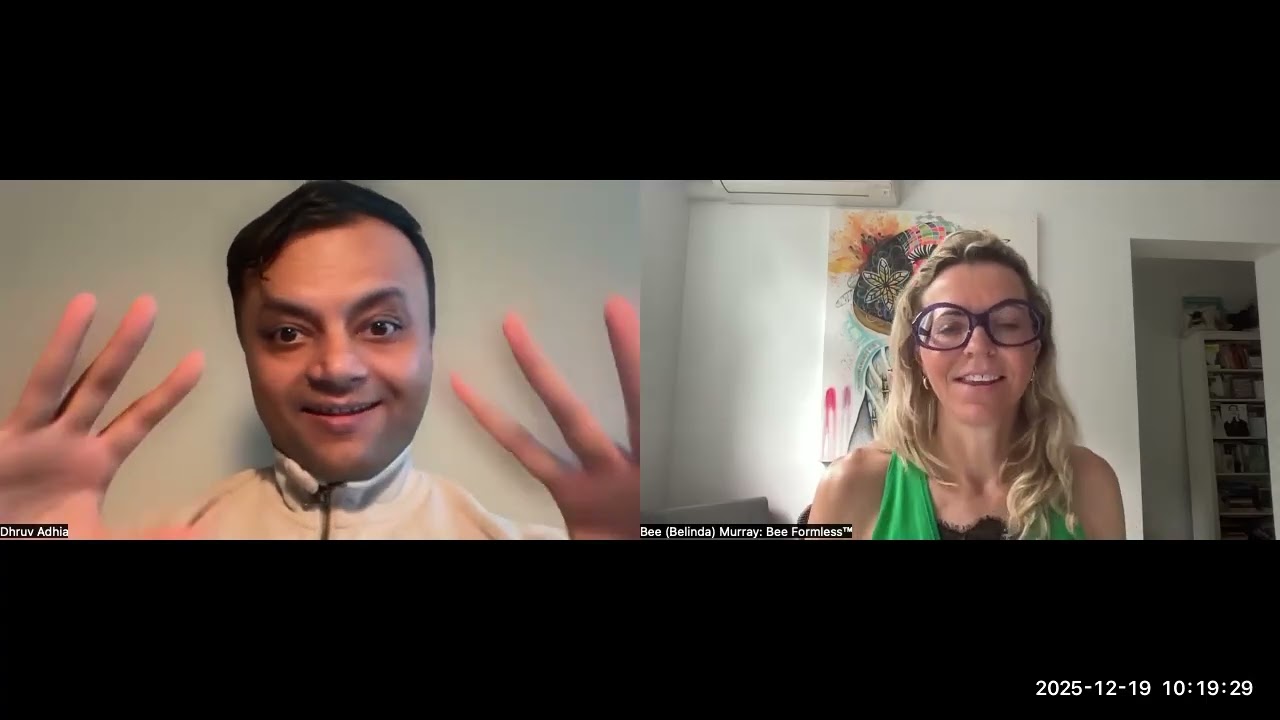
Breathwork That Fits Real Life: Nervous System Tech and Conscious Computing with Dhruv Adhia
Vayu co-founder Dhruv Adhia joins the Bee Formless™ podcast to explore conscious computing, haptic-guided breathwork, and how technology can help us regulate our nervous systems. Learn about HRV science, box breathing, and Vayu's mission to touch a billion lives.
Jan 25, 2026
Peaceful Computing: Why Your Technology Should Breathe With You, Not Against You
Peaceful Computing is a design philosophy where technology actively restores human peace rather than extracting attention. From Mark Weiser's 1991 vision of invisible computing to Stanford's breathwork neuroscience, we trace the intellectual history behind technology that serves your nervous system — and why Vayu was built to embody it.
Feb 8, 2026
What Is Conscious Computing? And Why Technology Needs to Learn to Breathe
The evolution from Calm Computing to Humane Tech left a gap: technology that actively cultivates awareness, agency, and wellbeing. Conscious Computing fills it.
Mar 3, 2026