Breathwork questions people actually ask on Reddit (honest answers)

Quick answer: The most common breathwork misconception is that calming breath means a bigger inhale. In most anxiety and panic states, the opposite is true. Your body needs a longer exhale, not more air. Everything else follows from that.
Try this technique in Vayu, free download
Haptic guidance on Apple Watch and Wear OS. Your first session is free.
These questions come directly from r/breathwork, r/Anxiety, r/Meditation, and r/PanicAttack. Not curated marketing questions. The ones people type at 2 AM when the standard advice isn't working.
Does breathwork actually do anything, or is it just placebo?
It produces measurable physiological changes, though not everything marketed as breathwork has the same evidence base.
The strongest evidence is around slow, controlled breathing at roughly 5-6 breaths per minute and its effect on Heart Rate Variability (HRV). Dozens of peer-reviewed studies show this pace raises HRV in real time, reduces cortisol, and lowers self-reported anxiety. A 2023 study in Cell Reports Medicine (Balban et al.) found that brief structured breathwork outperformed mindfulness meditation for mood and stress reduction in a controlled trial.
Where the evidence gets thin: specific claims about cellular oxygenation, "alkalizing the blood," or spiritual transformation have little to no rigorous backing. The nervous-system effects are real. The more ambitious marketing claims often aren't.
Why does deep breathing make my anxiety worse?
This is probably the most common complaint on r/Anxiety, and the answer is genuinely counterintuitive.
In a panic or acute anxiety state, most people are already over-breathing: too many breaths per minute, often through the mouth. This drops CO2 below normal levels, which causes exactly the symptoms people attribute to anxiety -- tingling in the hands and face, dizziness, chest tightness, air hunger. When someone in that state takes a "big deep breath," they dump even more CO2. Physical sensations worsen, the brain reads it as more danger, and the panic escalates.
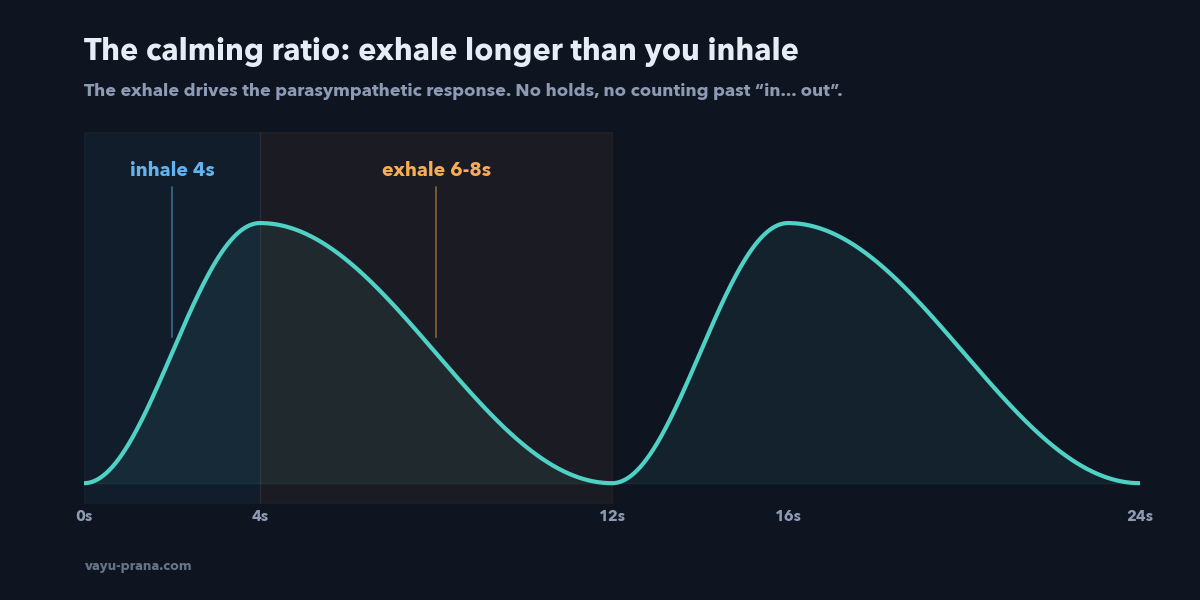
The fix is the opposite of instinct: a shorter, softer inhale through the nose, followed by a longer, slower exhale. Four seconds in, six to eight seconds out. No gulp, no gasp. The exhale is what activates your parasympathetic nervous system. The inhale activates your sympathetic system. If you're trying to calm down, the exhale is where to put your attention.
What's the difference between box breathing and 4-7-8?
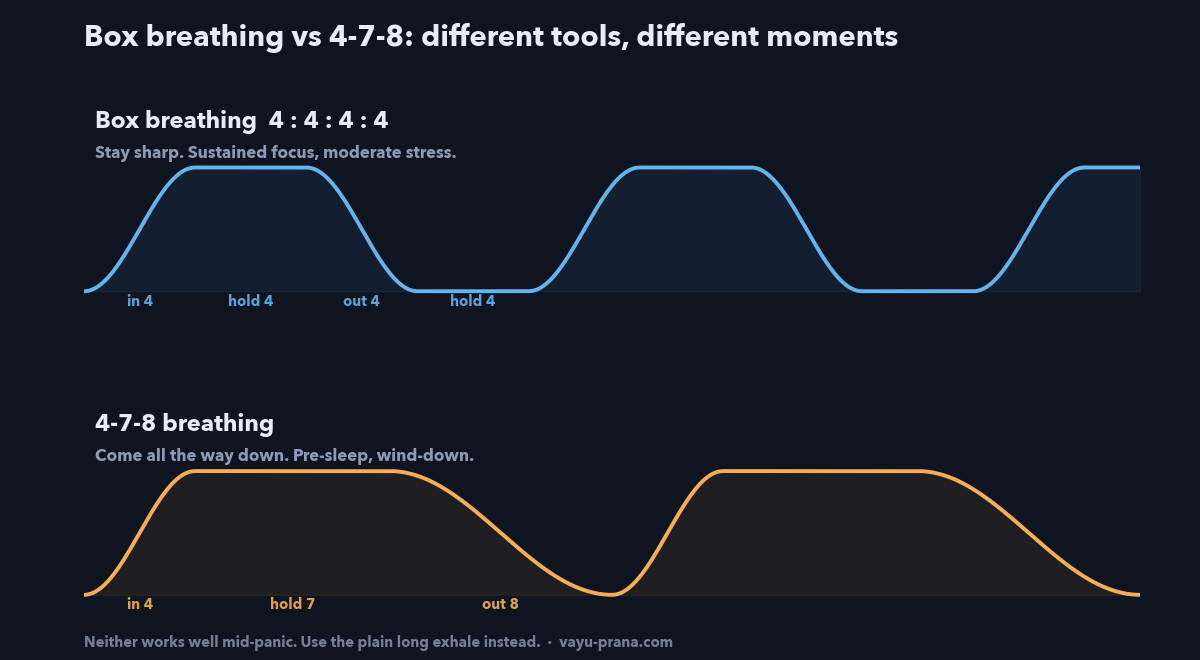
They're different tools for different moments.
Box breathing (4:4:4:4): Inhale 4, hold 4, exhale 4, hold 4. Equal sides, symmetrical. Good for sustained focus and moderate stress without sedation. The evidence is mostly clinical and anecdotal, but it's consistent -- this is the pattern used by Navy SEALs and first responders for a reason.
4-7-8 breathing: Inhale 4, hold 7, exhale 8. The long hold and long exhale make this sedating. Better for pre-sleep anxiety, wind-down, or any situation where you want to come fully down rather than stay functional. The 7-second hold builds mild CO2, which deepens the parasympathetic effect.
Practical rule: use box breathing when you need to stay sharp. Use 4-7-8 when you want to come all the way down.
Neither works well mid-panic. During an actual panic attack, breath holds can feel suffocating and the rigid count creates frustration. See the next question.
How do I breathe during an actual panic attack?
Not box breathing. Not 4-7-8. Both require holds and counts your brain can't reliably maintain during acute panic.
What works: a soft nasal inhale for about 4 seconds, then a slow easy exhale for 6-8 seconds. No holds. No counting past "in... out." Just focus on making the exhale longer than the inhale.
If your mouth wants to gulp air, close it and refuse to open it. Nose breathing slows the breath automatically and maintains CO2 better than mouth breathing.
One other technique that works quickly: the physiological sigh. Take a normal breath, then add one small extra sip of air at the top, then exhale everything slowly through your nose. This deflates collapsed air sacs in your lungs and produces a fast parasympathetic response. Research from the Huberman Lab group at Stanford has examined this in controlled settings -- it is genuinely fast and requires no counting.
Why can't I take a full breath, even when I'm not panicking?
This is "air hunger," and it's one of the most distressing anxiety symptoms because it feels like a medical problem.
The mechanism: people with chronic anxiety often develop a pattern of shallow, fast breathing as their baseline. This keeps CO2 perpetually below normal. Low CO2 activates smooth muscle around the airways, making them tighter. The result is a persistent sense of not getting a full breath, even when lung function tests come back completely normal.
The urge to solve it with a big inhale makes it worse, because a large inhale drops CO2 further.
The actual fix is retraining baseline breathing: slower rate (aim for 6-8 breaths per minute instead of the anxious 15-20), nasal breathing, and letting the belly move more than the chest. Patrick McKeown's work on reduced-breathing exercises (the Buteyko approach) is the most evidence-backed framework for this. It takes weeks, not days, but the symptom does resolve.
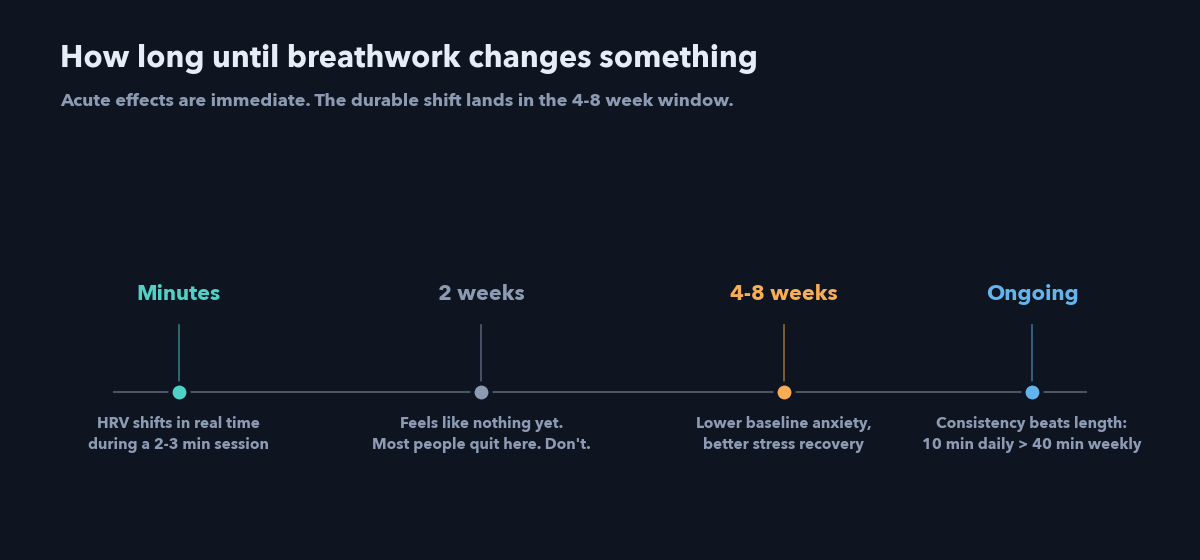
How long until breathwork actually changes something?
Acute effect: minutes. A 2-3 minute extended-exhale session shifts HRV measurably in real time. The "I feel calmer" sensation is real, not imagined, and you can watch it on a wearable if you have one.
Sustained shift: 4-8 weeks of daily practice. This is where most people quit too early. Studies on HRV improvement, reduced baseline anxiety, and better stress recovery consistently land in the 4-8 week window. Two weeks in, when nothing feels different yet, is not the time to stop.
One honest caveat: consistency matters more than session length. Ten minutes daily outperforms forty minutes once a week.
Is it safe to practice breathwork every day?
For slow, controlled patterns -- extended exhale, box breathing, 4-7-8, coherent breathing -- yes. Daily practice is safe and beneficial for nearly everyone.
For intense techniques like Wim Hof, Bhastrika, or hyperventilation-based protocols: daily use is not recommended by most practitioners. Some populations should avoid them entirely, including people with cardiovascular conditions, epilepsy, or anyone who is pregnant. These techniques produce real physiological stress. They're not inherently dangerous, but they're not casual daily tools.
If you're using breathwork primarily for anxiety or stress, you almost certainly don't need the intense protocols. The calming techniques have better evidence for anxiety specifically, and you can do them daily without concern.
What is Wim Hof breathing actually for, and is it safe for anxiety?
Wim Hof breathing is a sympathetic-system activator, not a calming tool. The rounds of rapid breathing followed by breath retention raise adrenaline, increase alertness, and can produce a short-lived euphoria. It was designed for cold exposure, physical performance, and acute stress resilience -- not for anxiety management.
For anxiety specifically, it's often the wrong tool. The hyperventilation phase drops CO2 sharply, which is precisely what triggers the physical symptoms of panic. Some people with well-managed anxiety find it useful in controlled settings once their baseline is stable. For someone struggling with air hunger or frequent panic, it can destabilize.
Short version: useful for morning energy, cold plunges, and building stress tolerance when you're in a stable place. Not a first-line approach if panic or anxiety is your primary concern.
How do I stop being hyperaware of my own breathing?
This comes up constantly in r/HealthAnxiety, and it's one of the harder ones because the obvious advice ("just don't think about it") doesn't work.
The mechanism: after a panic attack or health scare, the brain flags breathing as a potential threat. The nervous system starts monitoring it constantly. Every slight variation triggers a small alarm. Noticing the alarm makes it louder, which makes you more vigilant, which makes the alarm louder still.
What helps: interoceptive exposure -- deliberately paying attention to your breathing without trying to control it. This sounds backwards, but controlled exposure to the sensation reduces its threat value over time. It's the same mechanism behind exposure therapy for any anxiety trigger.
Breathing retraining also helps, because part of what drives hyperawareness is an underlying pattern disorder. When resting breath is smooth, slow, and nasal, there's less variation for the brain to alarm on.
What doesn't help: obsessive breath-monitoring, over-tracking every symptom, or trying to "fix" your breath every time you notice it. Neutrality toward the sensation is the goal. That takes time and sometimes benefits from working with a therapist familiar with somatic anxiety.
Does nose breathing vs mouth breathing actually matter?
More than most people expect.
Nose breathing filters and humidifies air, slows breath rate naturally, maintains higher CO2 (nasal passages create resistance), and produces nitric oxide, which dilates blood vessels and improves oxygen delivery at the tissue level. For anyone with anxiety or a breathing pattern disorder, switching to nasal breathing is one of the highest-leverage changes available.
Mouth breathing does the opposite: it increases breath rate, dumps CO2 faster, and keeps the sympathetic system more activated. It's the default under stress, which is why the habit is hard to break.
Practical starting point: close your mouth during all low-intensity activity and rest. If you breathe through your mouth during sleep, mouth tape (yes, actually) works. During moderate exercise, push the threshold of how fast you can move while maintaining nasal breathing only. The CO2 tolerance that builds from that practice is the same mechanism that reduces air hunger and panic frequency over time.
The short version
Most breathwork problems trace back to two things: CO2 sensitivity and the exhale-to-inhale ratio. Fix your baseline breathing pattern (slower, nasal, belly-led) and make your exhale longer than your inhale. Everything else -- the specific techniques, the holds, the retention protocols -- builds on that foundation.
If you're starting from scratch, the evidence-backed entry point is simple: 4 seconds in through your nose, 6-8 seconds out. Do that for 5 minutes before bed. Give it 6 weeks before evaluating whether it's working.
If you want real-time feedback on whether any of this is changing your nervous system, Vayu reads your HRV from your wearable during practice and shows you the shift happening live. It takes the guesswork out of whether a given technique is actually landing for your body.
This article is for educational purposes and is not medical advice. If you are experiencing symptoms that concern you, please consult a licensed healthcare provider.
Practice These Techniques with Vayu
Haptic breathing guidance on Apple Watch and Wear OS, paced on your wrist so you do not need the screen. Developed with the SFU Metacreation Lab, supported by NRC IRAP. Your first session is free.
Continue Reading

Does the Wim Hof Method Actually Work? What a 404-Person Study Found
Does the Wim Hof Method work? A 404-person 2025 study found real gains in energy and stress-handling that grew with practice. Here is the honest evidence read.
Jul 12, 2026
What Is the ROI of Corporate Wellness Programs? The Honest Answer, With Studies
Generic wellness programs fail randomized trials. Targeted, preventive, measured stress interventions do not. What the studies actually say about wellness ROI, and how to measure it so your program survives budget review.
Jul 9, 2026

Wim Hof Breathing: What the Science Actually Says
Wim Hof breathing is trending — but what does the science actually say? We break down the evidence, the real benefits, the risks, and how to practice it safely.
Feb 18, 2026