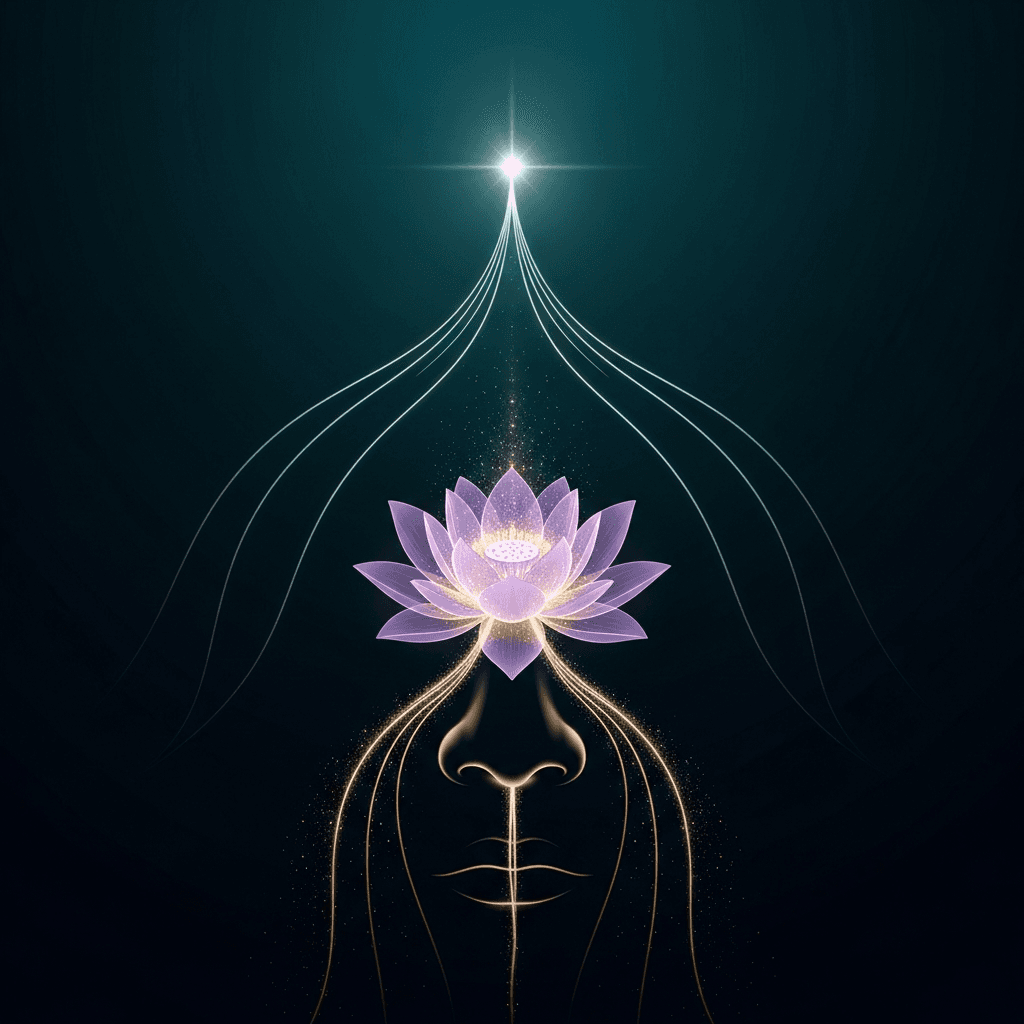
For over 2,000 years, yogic traditions have taught that breathing through the left and right nostrils has different effects on the body and mind. The left nostril was associated with cooling, calming energy (lunar, feminine, ida nadi). The right with warming, activating energy (solar, masculine, pingala nadi). Alternating between them — Nadi Shodhana — was said to purify the subtle energy channels and bring balance.
For a long time, this was dismissed as mysticism with no basis in biology.
Then neuroscientists started studying it.
Turns out the ancient yogis were describing — in their own language — something that is demonstrably, measurably real.
What Is Alternate Nostril Breathing (Nadi Shodhana)?
Alternate nostril breathing (Sanskrit: Nadi Shodhana Pranayama) is a breathing technique that involves alternating the breath between the left and right nostrils using the fingers of the right hand. Nadi means "channel" or "flow," and shodhana means "purification."
A typical cycle:
- Close the right nostril, inhale through the left
- Close the left nostril, exhale through the right
- Inhale through the right
- Close the right, exhale through the left
- That's one complete cycle
The technique can be practiced simply (just the alternation) or with breath holds (kumbhaka) for more advanced practitioners. It's one of the most widely studied pranayama techniques in modern research.
The Science: What Modern Research Has Found
The scientific story of alternate nostril breathing begins with a phenomenon called the nasal cycle.
The nasal cycle: You likely haven't noticed, but at any given moment, one of your nostrils is more open than the other. Every 1.5–4 hours, your nasal passages switch dominance — the congested nostril opens and the open one partially closes. This is controlled by the autonomic nervous system and varies predictably. It's not random: research has linked nasal cycle phase to changes in brain activity and autonomic function.
Hemispheric lateralization: A series of studies — most notably by David Shannahoff-Khalsa and colleagues at the Salk Institute — found that:
- Right nostril dominance correlates with left hemisphere activation (analytical, verbal processing) and sympathetic nervous system dominance
- Left nostril dominance correlates with right hemisphere activation (spatial, holistic processing) and parasympathetic dominance
This maps almost exactly onto the yogic ida/pingala distinction. The ancient description was metaphorical but physiologically accurate.
What alternating does: By manually alternating the nostrils, you prevent either system from dominating for too long — creating a kind of autonomic balance. Research effects include:
Reduced blood pressure: A 2013 study in the Journal of Hypertension found that 12 weeks of alternate nostril breathing significantly reduced both systolic and diastolic blood pressure in hypertensive patients.
Improved HRV: A 2014 study in Medical Science Monitor Basic Research found alternate nostril breathing increased parasympathetic tone and HRV compared to breath awareness control.
Reduced anxiety: Multiple studies in yoga and clinical populations show significant reductions in self-reported anxiety and perceived stress scores after regular alternate nostril breathing practice (Telles et al., International Journal of Yoga, 2013).
Enhanced cardiorespiratory performance: A study in Nepal Medical College Journal found improved forced vital capacity and VO2 max in practitioners after 6 weeks.
Cognitive effects: Several studies report improved spatial memory and executive function scores, consistent with the hemispheric balance hypothesis.
How to Practice Alternate Nostril Breathing: Step-by-Step
Hand position (Vishnu Mudra):
- Use your right hand. Fold your index and middle fingers toward your palm (or rest them on the bridge of your nose).
- Your thumb will close the right nostril.
- Your ring finger (sometimes with pinky) will close the left nostril.
The sequence:
Sit comfortably with your spine upright. Rest your left hand on your left knee. Take a moment to settle and observe your natural breath.
Exhale completely through both nostrils to begin.
Close your right nostril with your right thumb. Inhale slowly through your left nostril for a count of 4.
At the top of the inhale: Close your left nostril with your ring finger. Release your thumb. Exhale slowly through your right nostril for a count of 4 (or 8 for a longer practice).
Inhale through your right nostril for a count of 4 (right nostril remains open, left closed).
At the top: Close your right nostril again with your thumb. Release your ring finger. Exhale through your left nostril for a count of 4.
That's one complete cycle. Repeat for 5–10 cycles (2–5 minutes) as a beginner, building to 10–20 cycles.
The ratio: For basic practice, a 1:1 inhale-to-exhale ratio is fine. For deeper calming, a 1:2 ratio (4 in, 8 out) is more effective. Advanced practitioners add a breath hold: 1:1:2 or 1:4:2 (Sama Vritti or 4-7-8 variation within Nadi Shodhana).
Tips & Common Mistakes
Tips:
- Keep the breath smooth and even. Nadi Shodhana is not a technique for generating dramatic physiological effects — it's subtle and balancing. Avoid forcing the breath.
- Don't completely block the nostril. Apply gentle pressure — enough to redirect airflow, not a hermetic seal. Forcing air through a compressed nostril defeats the purpose.
- The left nostril first is traditional for calming. Starting with the left nostril (closing the right) is the classical approach for a calming, grounding practice. Starting with the right is more activating.
- Practice on an empty stomach. Particularly with breath holds, practicing after a meal is uncomfortable.
Common Mistakes:
- Rushing the transitions. The moment between closing one nostril and opening the other should be unhurried. Let the transition be part of the breath, not a scramble.
- Holding tension in the arm/shoulder. Keeping the right arm raised can cause tension to build. Some practitioners rest their elbow on a prop or use a different hand position for longer sessions.
- Expecting dramatic effects. Unlike Wim Hof breathing, Nadi Shodhana's effects are often subtle during the practice — a gradual settling, a shift in mental clarity. Give it a few minutes before judging whether "it's working."
How Vayu Helps
Vayu guides Nadi Shodhana timing with haptic cues so you can keep your eyes closed and focus entirely on the breath — rather than glancing at a timer or counting in your head. The app's HRV monitoring captures the subtle autonomic balance shifts that research associates with alternate nostril breathing, letting you observe the practice's effects in real time.
For practitioners who want to integrate Nadi Shodhana into a longer breathwork session — perhaps as a centering opener before resonance frequency breathing — Vayu's session builder makes this easy to sequence and track.
Download Vayu on iOS or Android →
FAQ
Q: What does alternate nostril breathing do for the brain? Research suggests alternate nostril breathing helps balance activation between the left and right brain hemispheres, linked to the autonomic nervous system's connection with the nasal cycle. Left nostril breathing is associated with increased right hemisphere activity and parasympathetic (calming) dominance; right nostril breathing with left hemisphere and sympathetic (activating) dominance. Alternating between them appears to promote autonomic balance, reduced blood pressure, improved HRV, and enhanced cognitive function, including spatial memory and executive processing.
Q: How long should you practice Nadi Shodhana each day? For measurable effects, most research protocols use 15–30 minutes of daily practice. As a beginner, 5–10 minutes (5–10 complete cycles) is a reasonable starting point. Even brief sessions (3–5 minutes) can provide immediate calming effects, making it useful as a situational tool. For long-term neurological and cardiovascular benefits, consistent daily practice over 4–12 weeks is where the research shows significant results.
Q: Is alternate nostril breathing safe during pregnancy? Basic alternate nostril breathing without breath holds (just the nostril alternation) is generally considered safe during pregnancy and is often recommended in prenatal yoga. However, breath retention (kumbhaka) techniques should be avoided during pregnancy, as prolonged breath holds can reduce oxygen availability. Always consult your healthcare provider before starting any new breathwork practice during pregnancy.