The most underrated interface
Software engineers spend their careers building APIs. Clean, well-documented interfaces that let systems talk to each other. Request in, response out. Predictable. Debuggable.
Your autonomic nervous system has one too. It's called your breath.
Unlike heart rate, skin conductance, or pupil dilation, which are read-only signals, breathing is the only autonomic function that is both involuntary and voluntarily controllable. It's bidirectional. You can read from it (observe your current state) and write to it (change your state deliberately).
This makes breath the most powerful biofeedback channel in the human body. And we're barely using it.
The physiology, briefly
Your autonomic nervous system has two branches. The sympathetic branch is the accelerator: fight-or-flight, cortisol, alertness, anxiety in excess. The parasympathetic branch is the brake: rest-and-digest, vagal tone, calm, disengagement in excess.
Health isn't about one being on and the other off. It's about flexibility, the ability to shift between states appropriately. This flexibility is measurable. It's called heart rate variability, or HRV.
High HRV means your nervous system can shift gears smoothly. Low HRV means you're stuck in one gear, usually the stress one.
Here's where breath comes in. Respiratory pattern directly modulates HRV. Slow, deep breathing, especially with extended exhalation, activates the vagus nerve and increases parasympathetic tone. Fast, shallow breathing does the opposite. This isn't meditation folklore. It's well-established cardiac vagal physiology.
The mechanism is called respiratory sinus arrhythmia (RSA): heart rate naturally increases during inhalation and decreases during exhalation. By controlling the breath, you're directly modulating the cardiac cycle. You're writing to the API.
Why most breathwork apps get it wrong
The current generation of breathwork tools treats breathing like a one-size-fits-all prescription.
"Feeling stressed? Try 4-7-8 breathing." "Need focus? Try box breathing." "Can't sleep? Try alternate nostril breathing."
This is like recommending the same antibiotic for every infection. The techniques are real, but the prescription model ignores the most important variable: where you are right now.
If your HRV is already high and your sympathetic tone is low, a long parasympathetic breathwork session might push you into under-arousal, that foggy, unmotivated state. If you're in acute sympathetic overdrive from a panic response, jumping straight to slow breathing may feel impossible and just create more frustration.
The intervention needs to meet the physiology. This requires three things: sensing (what is your current autonomic state?), matching (which technique, at which pace, with which ratio, is appropriate right now?), and adapting (as your state shifts mid-session, does the guidance adjust?).
This is what adaptive breathwork means. And it's what we're building at Vayu.
The HRV-breath feedback loop
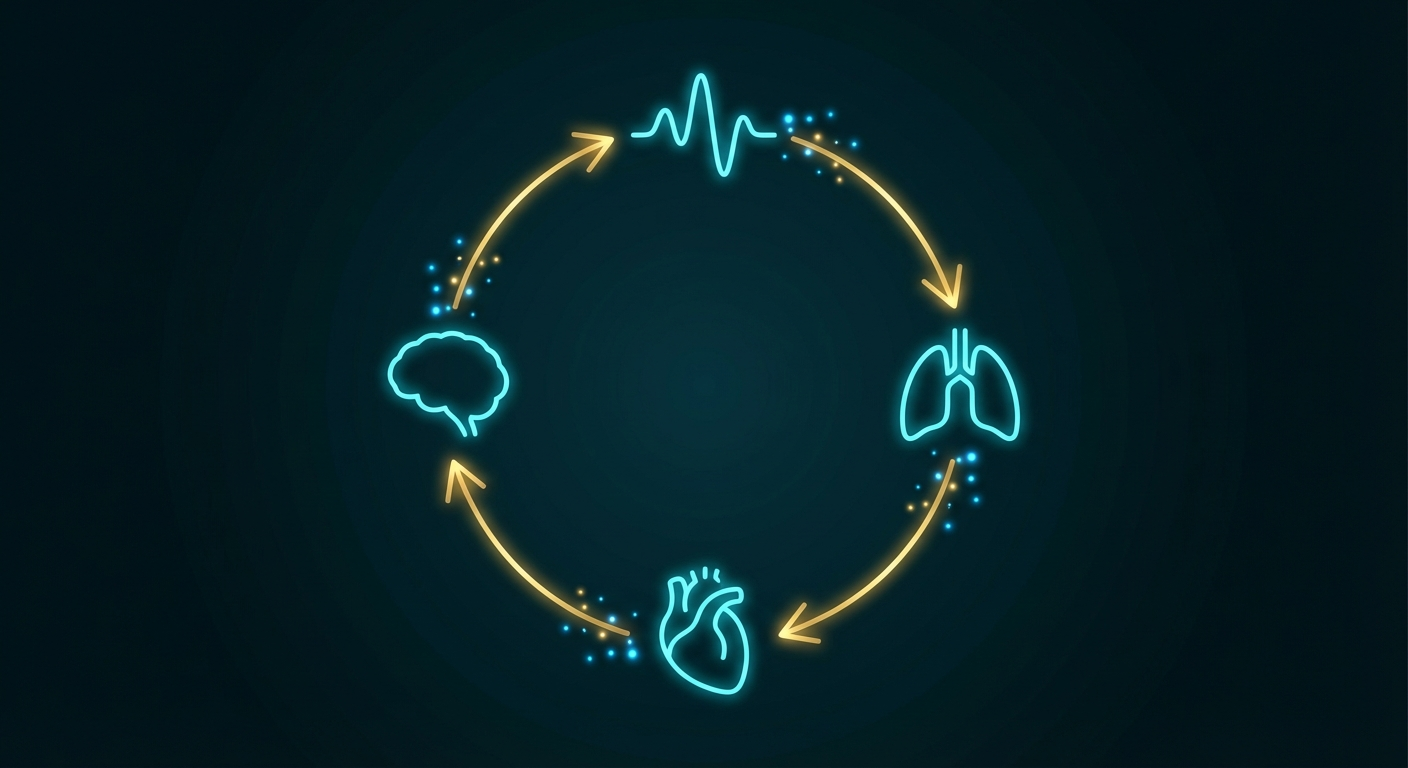
At Vayu, the core insight is that breathwork and HRV form a closed-loop feedback system. Measure current HRV, select a breathing technique, the user breathes, HRV shifts, re-evaluate, adjust the technique, and repeat.
This loop runs in real time. If the session is working and HRV is improving, the system deepens the protocol. If it's not working, if the user's physiology isn't responding as expected, the system adapts: shorter hold, different ratio, gentler pacing. Maybe it switches to haptic-only guidance so the cognitive load of following visual instructions drops out entirely.
The result is breathwork that feels intuitive rather than prescriptive. The technology disappears into the experience. You don't follow instructions. You follow your own body, with the system as a quiet guide.
What we mean by HumanOS
We sometimes describe Vayu's vision as "HumanOS," the idea that your body already runs an operating system, and our job is to build the interface layer for it.
Your ANS is the kernel. HRV is the process monitor. Breathwork is the system call. Sleep, nutrition, and movement are background services.
It's a metaphor, not a literal claim. But it captures something important: the most powerful computing system in the room isn't on your desk. It's in your body. And it's been running for 300,000 years without a user manual.
Vayu is that manual. Adaptive, personalized, grounded in physiology rather than ideology.
The bigger picture
When we talk about conscious computing, we're describing technology that serves this loop at every level. Not just breathwork, but any interface that reads from the nervous system (sensing physiological state), writes to the nervous system (providing interventions that shift state), and teaches the nervous system (building interoceptive awareness over time).
Breathwork is the most direct, most accessible, and most scientifically grounded entry point. But the principles extend to how we design notifications, schedule information delivery, structure digital environments, and build workspaces.
Your nervous system has an API. It's time we started using it responsibly.
Prana Labs is building Vayu, an AI-guided adaptive breathwork platform that uses real-time HRV data to personalize breathing interventions. Available on iOS and Android.