At Vayu, we've always believed that the nervous system deserves better tools — not louder ones. That belief led us to one of the most exciting academic partnerships in our history: a formal research collaboration with the Metacreation Lab for Creative AI at Simon Fraser University's School of Interactive Arts and Technology (SIAT), led by Dr. Philippe Pasquier.
This isn't a sponsorship or a surface-level affiliation. It's a genuine research inquiry into a question that has quietly driven Vayu's product development from day one: Can sound — specifically AI-generated soundscapes — deepen the impact of breathwork on the human nervous system?
About the Metacreation Lab
The Metacreation Lab for Creative AI has been at the forefront of generative systems and computational creativity since 2008. Based at SFU's SIAT, the lab is home to researchers, artists, cognitive scientists, and AI engineers who build systems capable of human-level creative output — from generative music agents to interactive biosignal-driven environments.
Dr. Philippe Pasquier, the lab's director, brings over 15 years of research into Music AI, embodied interaction, and co-creative systems. His work has explored how machines can listen, respond, and co-create — not as replacements for human expression, but as collaborators in it. With over 5,000 academic citations and an internationally recognized body of work in computational creativity, he's exactly the kind of partner that changes how you think about what your product can become.
What We're Researching Together
The focus of our collaboration sits at the intersection of two fields that have rarely spoken to each other directly: AI-generated soundscapes and breathwork science.
We know from existing research that breathwork — conscious regulation of breathing patterns — can measurably reduce cortisol, activate the parasympathetic nervous system, improve heart rate variability (HRV), and shift cognitive states. We also know that sound profoundly affects the nervous system: binaural beats, natural soundscapes, and rhythmic audio cues all influence brainwave activity and emotional regulation.
But what happens when you design sound specifically to respond to breath — in real time, algorithmically, without a human composer in the loop?
That's the question we're exploring with Metacreation Lab. Our research investigates:
- Adaptive soundscape generation: Using AI to create soundscapes that dynamically shift based on a user's respiration patterns and HRV data captured through Vayu's wearable system
- Physiological response measurement: Tracking how different types of AI-generated sound environments affect nervous system regulation during and after guided breathwork sessions
- Embodied interaction design: Moving beyond screen-based feedback toward a model where the body itself — through breath and haptic response — becomes the interface
Why Soundscapes? The Science Behind It
Sound is not a decorative addition to breathwork. It's a direct pathway into the autonomic nervous system.
Research in psychoacoustics has consistently shown that low-frequency resonant sounds, slow rhythmic patterns, and nature-based audio environments can activate the vagus nerve — the primary driver of the parasympathetic "rest and digest" response. Slow music with tempos below 60 BPM can literally entrain the heart rate and breath to follow its pace, a phenomenon known as entrainment.
Current breathwork tools mostly rely on visual timers, verbal cues, or static background music. None of these respond to the individual. They ask the body to adapt to the technology.
Vayu's approach — and the premise of our research with Metacreation Lab — reverses that. We're building systems where the technology adapts to the body. Where the soundscape you hear is a live, generative reflection of your own breath, creating a feedback loop that is at once calming and scientifically measurable.
Early Findings and What We're Building Toward
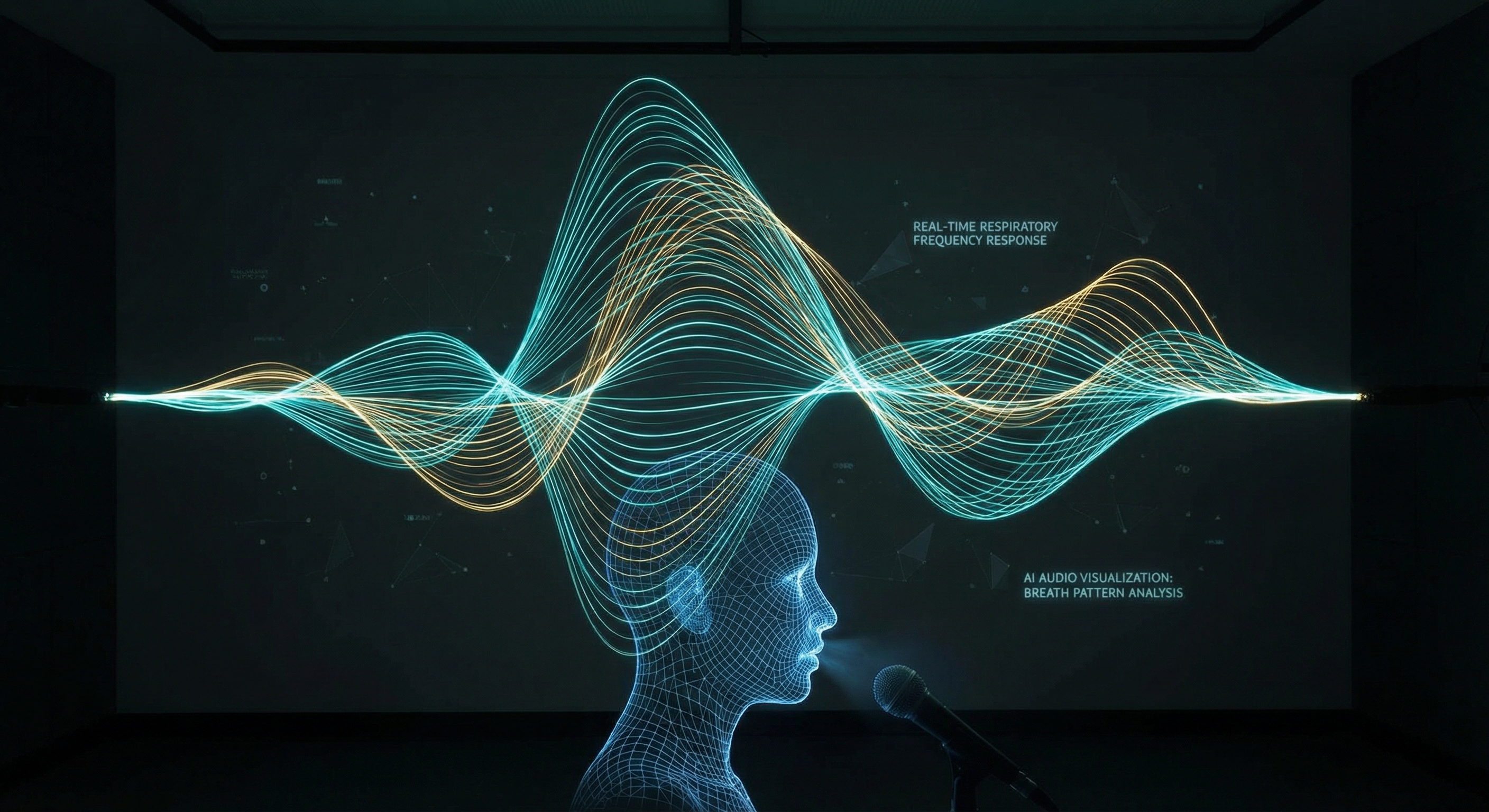
While this research is ongoing and results are being prepared for academic publication, early prototypes have yielded meaningful signals. Users interacting with breath-responsive generative soundscapes during Vayu sessions report heightened presence, deeper session engagement, and reduced cognitive intrusion — the tendency for the mind to wander during breathwork.
On the technical side, the Metacreation Lab's expertise in real-time generative audio systems is enabling us to design soundscapes that can shift in timbre, tempo, and spatial depth in response to biometric input with sub-second latency. This level of responsiveness is new territory for consumer wellness technology.
We're also exploring how these soundscapes could be used outside of guided sessions — as ambient environments for focus, sleep preparation, or post-exercise recovery — tailored dynamically to each user's physiological state.
What This Means for Vayu Users
This research will directly shape future Vayu features. Our goal is to bring AI-generated, breath-responsive soundscapes into the app in a way that feels effortless — not like a feature you configure, but like an environment that simply knows how to meet you where you are.
In the near term, this collaboration also strengthens the scientific foundation behind everything Vayu does. We're not a wellness app making vague claims about stress reduction. We're a team actively working with world-class researchers to understand, measure, and optimize the relationship between breath, sound, and the nervous system.
That matters to us. And we think it should matter to you.
A Note on the Partnership
Academic-industry research collaborations can sometimes feel like checkbox exercises. This one isn't. The Metacreation Lab's work on the Vayu project treats breath not as data to be optimized, but as a living signal to be felt, interpreted, and shared. That philosophy aligns exactly with how we think about our users' nervous systems.
We're grateful to Dr. Pasquier and the Metacreation Lab team for bringing their expertise in Creative AI, embodied interaction, and generative systems to this work. We believe the intersection of computational creativity and human physiology is one of the most underexplored frontiers in technology — and we're just getting started.
Follow our research updates at metacreation.net/projects/vayu. Vayu is available on iOS — learn more at vayu-prana.com.