The oldest technology
Long before anyone called it "technology," humans had a tool for regulating their internal state. It didn't require batteries, a subscription, or a Wi-Fi connection. It was breath.
The Yoga Sutras of Patanjali, written around 200 BCE, describe pranayama, the conscious regulation of breath, as the fourth limb of yoga. It sits between physical postures (asana) and the withdrawal of senses (pratyahara). It wasn't exercise. It was a technology for shifting consciousness.
The specific techniques were sophisticated. Nadi Shodhana (alternate nostril breathing) for balancing and calming. Kapalabhati (skull-shining breath) for rapid diaphragmatic pumping and energy. Bhramari (humming breath) for anxiety and focus through vibration. Ujjayi (victorious breath) for sustained attention during movement through constricted glottis breathing.
These weren't invented randomly. They were refined over thousands of years through systematic observation of internal states. Arguably the longest-running human experiment in interoceptive biofeedback.
What modern science says
It took 5,000 years for Western science to start catching up. Here's what we now know.
Slow breathing at 6 breaths per minute maximizes HRV. This rate creates resonance between the respiratory and cardiovascular systems, a phenomenon called respiratory sinus arrhythmia. Lehrer and Gevirtz demonstrated in 2014 that breathing at approximately 0.1 Hz produces the largest oscillations in heart rate, strengthening the baroreflex and increasing vagal tone. Pranayama practitioners have been breathing at approximately this rate for millennia. They didn't call it "resonance frequency breathing." They called it natural breath.
Extended exhalation activates the parasympathetic nervous system. The 4-7-8 technique (inhale 4 counts, hold 7, exhale 8) works because the long exhalation disproportionately stimulates vagal activity. This maps directly to pranayama ratios where exhalation is typically twice the length of inhalation.
Nasal breathing produces nitric oxide. Breathing through the nose, not the mouth, releases nitric oxide from the paranasal sinuses, which acts as a bronchodilator and vasodilator. Nadi Shodhana's insistence on nasal breathing wasn't mystical. It was biochemically advantageous.
Breath holding (kumbhaka) increases CO2 tolerance. Brief breath retention raises carbon dioxide levels, which improves the efficiency of oxygen delivery to tissues through the Bohr effect. This is now used in athletic training and anxiety treatment. The yogis practiced kumbhaka as a route to mental stillness. The physiological mechanism supports both interpretations.
Humming extends exhalation and stimulates the vagus nerve. Bhramari pranayama produces vibration in the throat and sinuses. Research shows that humming increases nasal nitric oxide 15-fold (Weitzberg & Lundberg, 2002) and that vocal vibration at specific frequencies activates the vagal pathways. The same mechanism used in modern vagal nerve stimulation therapy.
The convergence is striking. Almost every traditional pranayama technique has a modern physiological explanation that validates its use.
Where AI enters the picture
If the ancients figured out what works, what does modern technology add?
Three things.
Personalization at scale. Traditional pranayama was taught one-to-one, guru to student, with the teacher observing the student's constitution, current state, and capacity. The instruction was deeply personalized.
This doesn't scale. A YouTube video of 4-7-8 breathing can't observe whether you're a 25-year-old athlete with high baseline HRV or a 55-year-old executive in chronic sympathetic overdrive. The same technique at the same pace will affect these two people completely differently.
AI changes this. By integrating real-time HRV data from wearables, breathing pattern analysis, and longitudinal health data, an AI system can approximate the personalized observation that a skilled pranayama teacher provides, and do it for millions of users simultaneously.
Vayu's adaptive engine selects technique, pace, ratio, and duration based on your physiological state at the moment you begin. It's not prescriptive. It's responsive.
Real-time adaptation. A human teacher adjusts instructions as they observe the student. "Slow down. You're forcing the exhalation. Let it flow." This mid-session adaptation matters. A technique that's right at minute one may be wrong at minute five as the body responds.
Vayu monitors the session continuously. If your HRV improves rapidly, the system can deepen the practice: longer holds, slower rates. If it detects resistance (rising heart rate, irregular rhythm), it eases off. This mirrors what an expert teacher does intuitively, but with millisecond precision across physiological channels the teacher can't directly observe.
Pattern recognition over time. A skilled teacher might remember that a student always struggles with breath retention on Mondays because of work stress. But they can't track 365 days of physiological data across 10,000 students.
Machine learning can. Over weeks and months, Vayu builds a model of each user's respiratory and autonomic patterns: circadian rhythms, weekly stress cycles, seasonal variation, the physiological impact of specific life events. This allows predictive guidance: suggesting a parasympathetic session before the system detects your Tuesday afternoon cortisol spike, based on 12 weeks of learned patterns.
Respecting the source
We approach this intersection with respect, not appropriation.
Pranayama is not a "wellness hack." It's a contemplative technology embedded in a rich philosophical tradition that includes ethical precepts, physical preparation, sensory discipline, concentration, meditation, and ultimately a state of unified awareness. Reducing it to "breathing exercises for stress" strips the context that gives the practices their depth.
At the same time, dogmatically refusing to integrate modern science with traditional knowledge does a disservice to both. The yogis were empiricists. They observed internal states with extraordinary precision and developed techniques based on those observations. Modern physiology offers a complementary lens that explains why these techniques work, enabling better teaching, safer practice, and wider accessibility.
Our approach at Prana Labs: credit the tradition (every technique in Vayu is identified by its Sanskrit name alongside its modern description), validate with science (we reference peer-reviewed research on the physiological mechanisms), and adapt with technology (we use AI to personalize the ancient wisdom, not to replace it, but to make it accessible to people who don't have access to a skilled teacher).
The name "Prana" is deliberate. Prana means life force, breath, vital energy. "Vayu" means wind, the moving breath. These aren't brand names borrowed for marketing. They're acknowledgments of the tradition that made this work possible.
The convergence
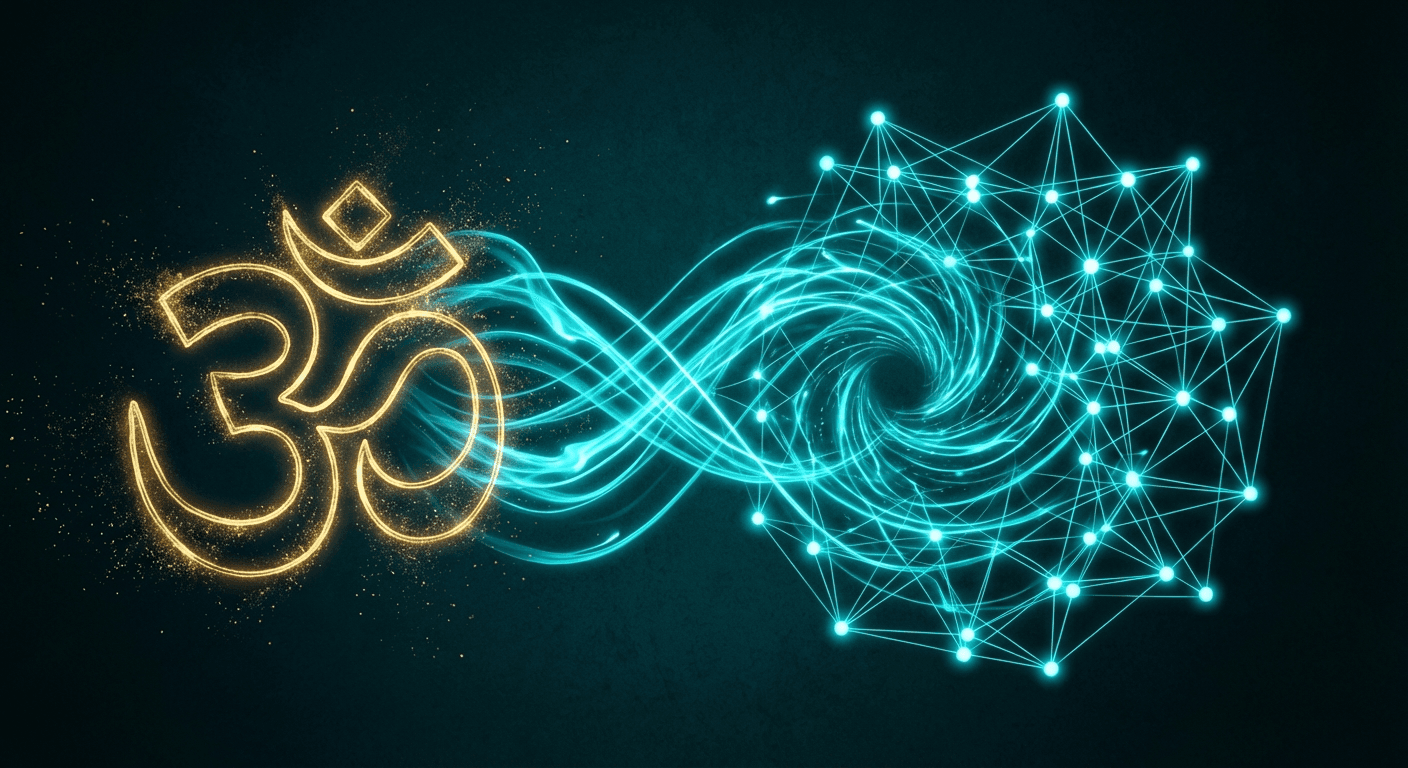
We're living in a remarkable moment. Ancient contemplative traditions and modern computational science are arriving at the same conclusions about human physiology, attention, and wellbeing, from completely different starting points.
The pranayama practitioners said: regulate your breath, and you regulate your mind.
The neuroscientists say: modulate respiratory rate, and you modulate autonomic balance, vagal tone, HRV, and cognitive function.
Same truth. Different vocabulary.
Conscious computing sits at this convergence. Using the precision of modern technology to deliver the wisdom of ancient practice, personalized to each human body, in real time.
The breath is old. The algorithms are new. Together, they're more powerful than either alone.
Dhruv Adhia is the co-founder of Prana Labs and a PhD researcher at Simon Fraser University, where his research bridges human-computer interaction, biosignal processing, and contemplative technology.