Breathing at Altitude: What Changes and How to Adapt
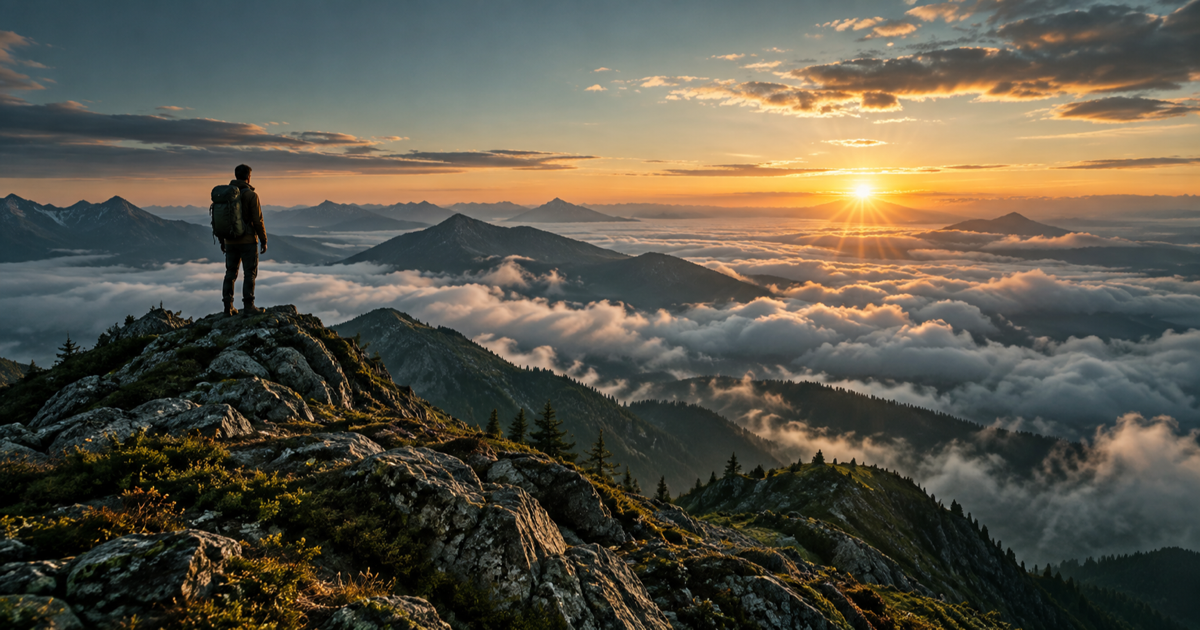
You land in Cusco, or Leadville, or Lhasa, and within a few hours something feels wrong. A headache building behind the eyes. Stairs that leave you winded in a way that feels faintly insulting. Sleep that never quite arrives.
Try this technique in Vayu, free download
Haptic guidance on Apple Watch and Wear OS. Your first session is free.
Your breathing has already changed without your permission. Understanding what it is doing, and what it needs from you, is the difference between a ruined first three days and a good trip.
What Actually Changes at Altitude
A common misconception is worth clearing up first: the air at altitude is not thinner in oxygen percentage. It is still about 21% oxygen at 4,000 metres, the same as at sea level.
What falls is barometric pressure. At 3,500 metres, atmospheric pressure is roughly 65% of sea level, so each breath contains about a third fewer oxygen molecules in the same volume. The partial pressure of oxygen drives diffusion across your lung membranes, and lower pressure means less oxygen crossing into your blood per breath.
Your body detects this quickly and responds with a cascade of adaptations.
The hypoxic ventilatory response. Within minutes, oxygen-sensing chemoreceptors in the carotid bodies detect the drop and increase your breathing rate and depth. This is automatic and immediate.
The respiratory alkalosis problem. Here is where it gets interesting, and where most altitude advice goes wrong. Breathing more does not only take in more oxygen. It also blows off more carbon dioxide. Your blood CO2 falls, your blood becomes more alkaline, and that alkalinity suppresses your drive to breathe.
So you end up in a genuine physiological conflict: low oxygen says breathe more, low CO2 says breathe less. Your body sits between the two signals, under-ventilating relative to what the hypoxia actually demands.
Renal compensation. Over 24 to 72 hours, your kidneys begin excreting bicarbonate to correct the alkalosis. As blood pH normalises, the brake on breathing releases and ventilation can rise to where it should be. This is the single biggest reason acclimatisation takes days rather than hours.
Later adaptations follow: increased red blood cell production over weeks, and increases in capillary density and mitochondrial efficiency over months.
Periodic Breathing: Why You Cannot Sleep
If you have woken at altitude gasping, convinced something was badly wrong, this is almost certainly what happened.
Periodic breathing, also called Cheyne-Stokes respiration at altitude, affects the majority of people sleeping above about 3,000 metres. It is a direct consequence of the oxygen and CO2 conflict.
The cycle: low oxygen drives a burst of deep rapid breathing, which blows off CO2, which then removes the drive to breathe, producing a pause of 10 to 30 seconds. During the pause, oxygen falls again, which triggers another burst. And around it goes, all night.
The pauses often end with a gasp and a brief arousal. You may not remember waking, but your sleep is heavily fragmented, which explains the particular exhausted, headachy quality of the first few nights.
This is normal at altitude and not, by itself, dangerous. It typically improves substantially over the first week as renal compensation proceeds. It is distinct from sleep apnea, since the airway is open and the problem is control rather than obstruction.
What Breathing Practice Can and Cannot Do
Being precise here matters, because altitude illness kills people who ignore it.
What it can do:
- Improve comfort and reduce panic. Breathlessness at altitude is alarming, and the anxiety response worsens the experience considerably.
- Support efficient breathing mechanics. Diaphragmatic breathing moves more air per unit of effort than upper-chest breathing, which matters when respiratory work is elevated.
- Help with sleep onset, where fragmentation and anxiety compound each other.
- Pressure breathing genuinely helps during exertion. More on this below; it is the one technique with a clear mechanical rationale.
What it cannot do:
- It cannot replace acclimatisation. The rate-limiting step is renal bicarbonate excretion, which takes days and is not accelerated by breathing technique.
- It cannot treat altitude sickness. The treatment for acute mountain sickness that is not improving is descent. For HACE or HAPE, the treatment is immediate descent, and it is an emergency.
- It cannot make a fast ascent safe. No technique substitutes for a sensible ascent profile.
- Hyperventilation-style breathwork is a poor idea at altitude. Techniques involving voluntary heavy over-breathing worsen the alkalosis that is already suppressing your drive to breathe, and breath holds on top of existing hypoxia are genuinely unwise. Save the intense stuff for sea level.
Pressure Breathing: The Technique Worth Knowing
Pressure breathing is used by mountaineers and has a sound mechanical basis. It is essentially pursed-lip breathing applied to exertion at altitude.
Inhale normally through the nose or mouth.
Exhale forcefully against partly closed lips, making an audible controlled "pff" sound. You are exhaling against resistance.
Match it to your step rhythm when climbing: one pressure breath per step on steep ground, or every second step on moderate terrain.
Why it works: exhaling against resistance raises pressure in the airways and alveoli, which keeps small airways from collapsing and improves the pressure gradient for oxygen diffusion. It also enforces a fuller exhale, clearing more stale air so the next breath brings in more fresh air.
The audible sound is not theatre. It is how you confirm you are producing real resistance.
Rest Step and Rhythmic Breathing
The second technique that matters on the hill is coordination between breath and movement.
Pick a fixed pattern and hold it: two steps per inhale and two steps per exhale on moderate ground, dropping to one step per breath as it steepens. The specific ratio matters less than consistency, because an irregular pattern lets you drift into oxygen debt without noticing.
Pair it with the rest step: at the end of each step, briefly straighten your rear leg and let your skeleton rather than your muscles carry your weight for an instant. Combined with rhythmic breathing, it produces a pace you can sustain for hours.
The reliable signal that your pace is right: you can still speak in short sentences. If you cannot, you are going too fast for your current acclimatisation, regardless of how fit you are.
Tips & Common Mistakes
Tips:
- Climb high, sleep low. The oldest rule in mountaineering and still the best. Above 3,000 metres, increase sleeping altitude by no more than 300 to 500 metres per night, with a rest day every 1,000 metres.
- Hydrate deliberately. Ventilation is higher and the air is dry, so respiratory water loss rises substantially. Dehydration mimics and worsens altitude symptoms.
- Sleep propped up slightly if periodic breathing is disturbing you. Some people find a raised head position reduces the severity of the cycling.
- Ask about acetazolamide. It works by promoting bicarbonate excretion, which directly accelerates the rate-limiting step in acclimatisation. It is the one intervention that genuinely speeds the process, and it is a conversation for a travel medicine clinician before you go.
- Avoid alcohol and sedatives on the first nights. Both suppress ventilation, which is precisely the wrong direction.
Common Mistakes:
- Interpreting normal breathlessness as fitness failure and pushing harder. Your breathlessness is appropriate to the oxygen available. Pushing through it is how mild symptoms become serious ones.
- Doing intense breathwork or breath holds to "train" for altitude while at altitude. Wrong place for it.
- Ignoring a headache that does not respond to fluids and rest. It is the earliest and most important warning sign.
- Flying or driving directly to high altitude and sleeping there the same night. The most common cause of avoidable altitude sickness.
Warning Signs: When to Descend
This section matters more than anything else in this article.
Acute mountain sickness presents as headache plus some combination of nausea, fatigue, dizziness, and poor sleep. Mild cases often settle with rest, fluids, and no further ascent. Do not ascend further while symptomatic.
Descend immediately, treating it as an emergency, for any of these:
- Ataxia, meaning loss of coordination or inability to walk a straight line heel to toe. This is the single most important sign of high altitude cerebral edema.
- Confusion, altered behaviour, or drowsiness
- Severe headache unresponsive to analgesia
- Breathlessness at rest, particularly with a cough producing frothy or pink sputum, which suggests high altitude pulmonary edema
- Chest tightness with gurgling breathing sounds
HACE and HAPE can both be fatal within hours. Descent is the treatment. No breathing technique, supplement, or overnight rest substitutes for losing altitude.
How Vayu Helps
Vayu is useful at altitude for a narrow and honest purpose: the wind-down before sleep, and the anxiety that breathlessness generates.
Fragmented sleep from periodic breathing is one of the least pleasant parts of the first few nights, and anxiety about it makes sleep onset worse. A slow guided session in the dark, paced by haptics rather than a screen, gives you something steady to follow without the bright display that further delays sleep.
What it will not do is acclimatise you. That is a matter of ascent rate and kidney physiology, and it takes the days it takes.
Download Vayu on iOS or Android →
FAQ
Q: Why do I wake up gasping at high altitude? This is periodic breathing, and it affects most people sleeping above roughly 3,000 metres. Low oxygen triggers a burst of deep breathing, which blows off carbon dioxide, which then removes the stimulus to breathe and produces a pause of 10 to 30 seconds. Oxygen falls again and the cycle repeats. It is a normal consequence of altitude physiology rather than a sign of danger, and it usually improves substantially over the first week.
Q: Can breathing exercises prevent altitude sickness? No. Acclimatisation is limited by how fast your kidneys excrete bicarbonate to correct the respiratory alkalosis that altitude creates, and that takes days regardless of technique. Breathing practice can improve comfort, support efficient mechanics, and help with sleep, but a sensible ascent profile is what actually prevents altitude sickness. Avoid intense hyperventilation-based breathwork at altitude, since it worsens the alkalosis already suppressing your breathing drive.
Q: What is pressure breathing and does it work? Pressure breathing means exhaling forcefully against pursed lips, producing an audible sound, usually timed to your steps while climbing. It raises airway pressure, helps keep small airways open, improves the gradient for oxygen diffusion, and enforces a more complete exhale so the next breath is fresher. It is widely used by mountaineers and has a sound mechanical rationale for exertion at altitude, though it supports rather than replaces proper acclimatisation.
Practice These Techniques with Vayu
Haptic breathing guidance on Apple Watch and Wear OS, paced on your wrist so you do not need the screen. Developed with the SFU Metacreation Lab, supported by NRC IRAP. Your first session is free.
Continue Reading

The Three-Minute Window: Breathing for Faster Exercise Recovery
Heart rate recovery is one of the most useful markers in training. What slow breathing between sets actually does, what it does not do, and why hands on knees beats hands on head.
Sep 15, 2026

Teaching Kids to Breathe: What Actually Works, by Age
Telling an upset child to take a deep breath usually fails, for three specific reasons. A developmental guide to breathing games that work from age three to the teenage years.
Sep 15, 2026

Sleep Apnea and Breathwork: What Helps, What Is Hype
Myofunctional therapy cuts apnea severity by about half. That is real, and it is not a cure. An honest look at where breathing exercises fit, and where they are dangerous to rely on.
Sep 15, 2026