30 Billion Dollars in Wellness Apps. Zero Interventions.


The global digital health market crossed $200 billion in 2023. Mental health and wellness apps alone represent a segment valued at over $30 billion, growing at roughly 17% annually. By 2030, analysts project the wellness app market will exceed $60 billion.
Try this technique in Vayu, free download
Haptic guidance on Apple Watch and Wear OS. Your first session is free.
For all of that money, ask yourself: how many of these apps have actually changed your physiology?
Not how you feel. Not your mood rating. Your actual physiological state: your cortisol, your HRV, your autonomic balance.
The answer, almost universally, is zero.
The Three Business Models That Dominate Wellness Tech
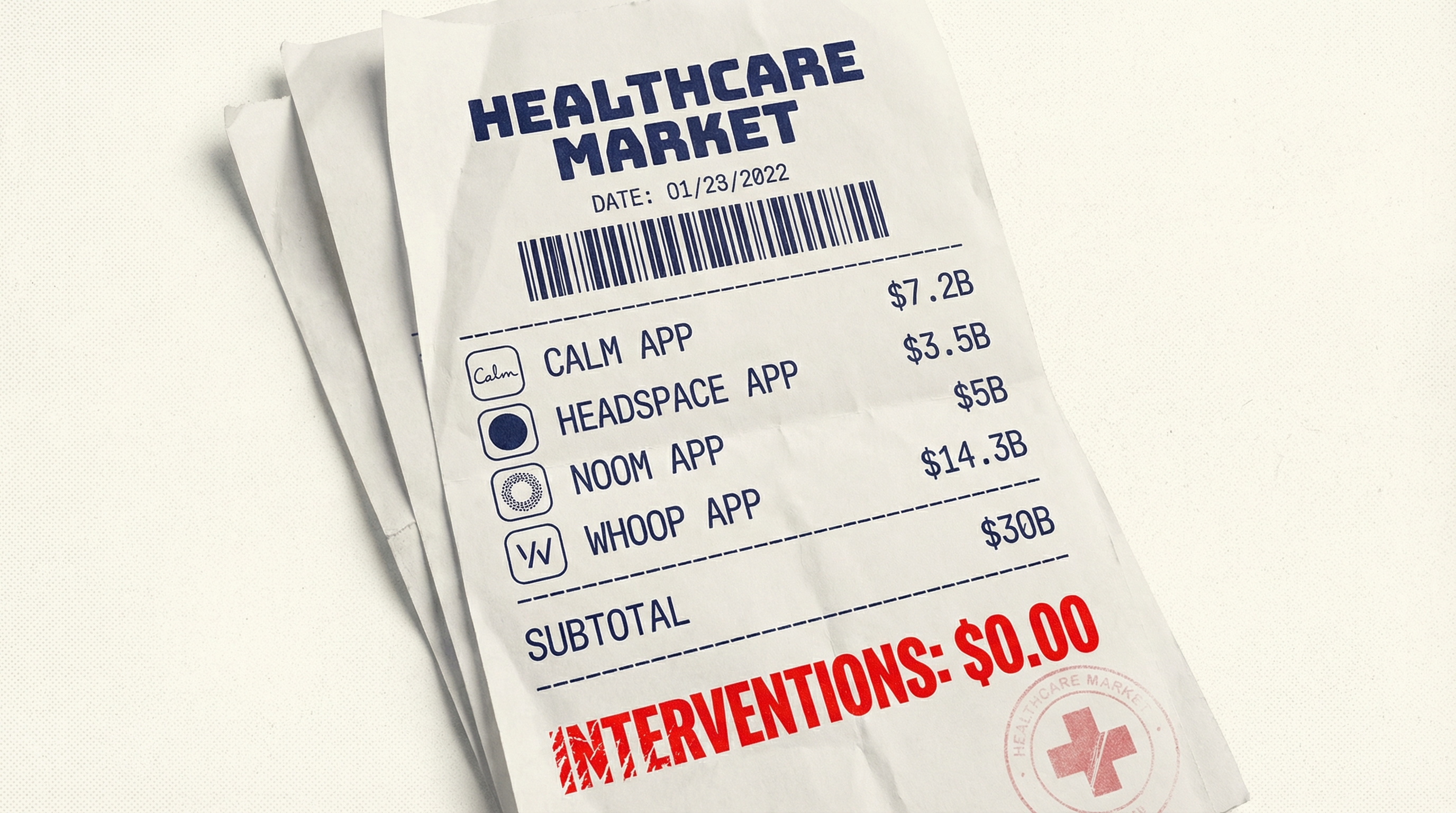
Walk through the wellness app space and you find the same three models, recycled endlessly:
Content delivery. Calm, Headspace, Insight Timer. Guided meditations, sleep stories, breathing exercises presented as video or audio, consumed passively. These apps are essentially podcasts with better branding. They can't measure whether you're stressed. They can't adapt to your physiological state. They deliver the same content regardless of what your nervous system needs right now.
Passive monitoring. Oura, Whoop, Apple Watch, Garmin. Extraordinary hardware, genuinely useful data, and zero actionable intervention. They show you the score. They do not change it. As Dhruv Adhia, founder of Vayu, put it: "I had richer physiological data than most clinical researchers ever had access to. And every app I owned told me I was declining. None of them told me what to do."
Content plus community. Peloton. Noom. The gamified engagement loop. These work for fitness because the intervention is the workout. But for stress, anxiety, and ANS dysregulation, showing up to a class is not the mechanism. The mechanism is physiological modulation, and that requires biofeedback.
None of these models connects the data to an intervention.
Why Nobody Connects Data to Intervention
The honest answer is that connecting data to intervention is hard. It requires biometric data from a device people already wear, a validated intervention protocol, and a feedback mechanism that shows the intervention working. That's a much harder engineering problem than streaming audio or plotting a sleep score.
It also requires a clinical thesis. Most wellness companies are built by content creators and consumer app developers, not by people who deeply understand autonomic physiology. The industry has been content to monetize the anxiety of not knowing, rather than building tools that actually fix it.
There's also a commercial incentive problem. If your app genuinely resolves stress in real time, users might need it less. If it merely shows users how stressed they are, they keep coming back for more data. Measurement is a better subscription model than resolution.
What Connecting Data to Intervention Actually Requires
The research is clear about what works for real-time stress modulation. HRV biofeedback (pairing live autonomic data with guided breath control) produces clinically significant reductions in anxiety, blood pressure, and cortisol, with effects that accumulate over time and improve baseline resilience. This is documented across dozens of peer-reviewed studies in journals including Applied Psychophysiology and Biofeedback and Frontiers in Human Neuroscience.
The intervention exists. The hardware to deliver it (Apple Watch, WearOS devices) is already on 500 million wrists. The science has been validated.
What's been missing is a product company willing to actually build an intervention instead of another monitoring dashboard.
The Gap Is the Opportunity
Vayu was built on one thesis: the wellness industry has confused measurement for medicine. Thirty billion dollars in apps, and none of them will tell your nervous system to calm down right now.
We do. HRV read from your existing wearable after each session, shaping the next one. Haptic-guided breathwork that shifts your ANS state in under five minutes. Visible feedback that shows you it's working. 70,000+ downloads. 15+ countries. 64% still practicing at 30 days in our strongest 2025 cohort.
The $30 billion wellness industry is almost entirely selling measurement. The market for actual intervention is wide open.
Try Vayu, the wellness app that connects your data to your nervous system.
Practice These Techniques with Vayu
Haptic breathing guidance on Apple Watch and Wear OS, paced on your wrist so you do not need the screen. Developed with the SFU Metacreation Lab, supported by NRC IRAP. Your first session is free.
Continue Reading

You Know You're Stressed. So Does Your Watch. Now What?
Your watch knows you're stressed. It has for years. The problem isn't detection. It's that nothing bridges the gap from diagnosis to intervention. That's not a willpower failure. It's a product gap. Here's what closing it actually looks like.
Mar 22, 2026
What Is the ROI of Corporate Wellness Programs? The Honest Answer, With Studies
Generic wellness programs fail randomized trials. Targeted, preventive, measured stress interventions do not. What the studies actually say about wellness ROI, and how to measure it so your program survives budget review.
Jul 9, 2026
Why Your Workplace Needs to Breathe: The Case for Autonomic-Aware Enterprise Wellness
Corporate wellness is an $80B industry that isn't working. The missing layer: real-time nervous system support through micro-interventions that fit into a workday.
Mar 3, 2026