
You Know You're Stressed. So Does Your Watch. Now What?
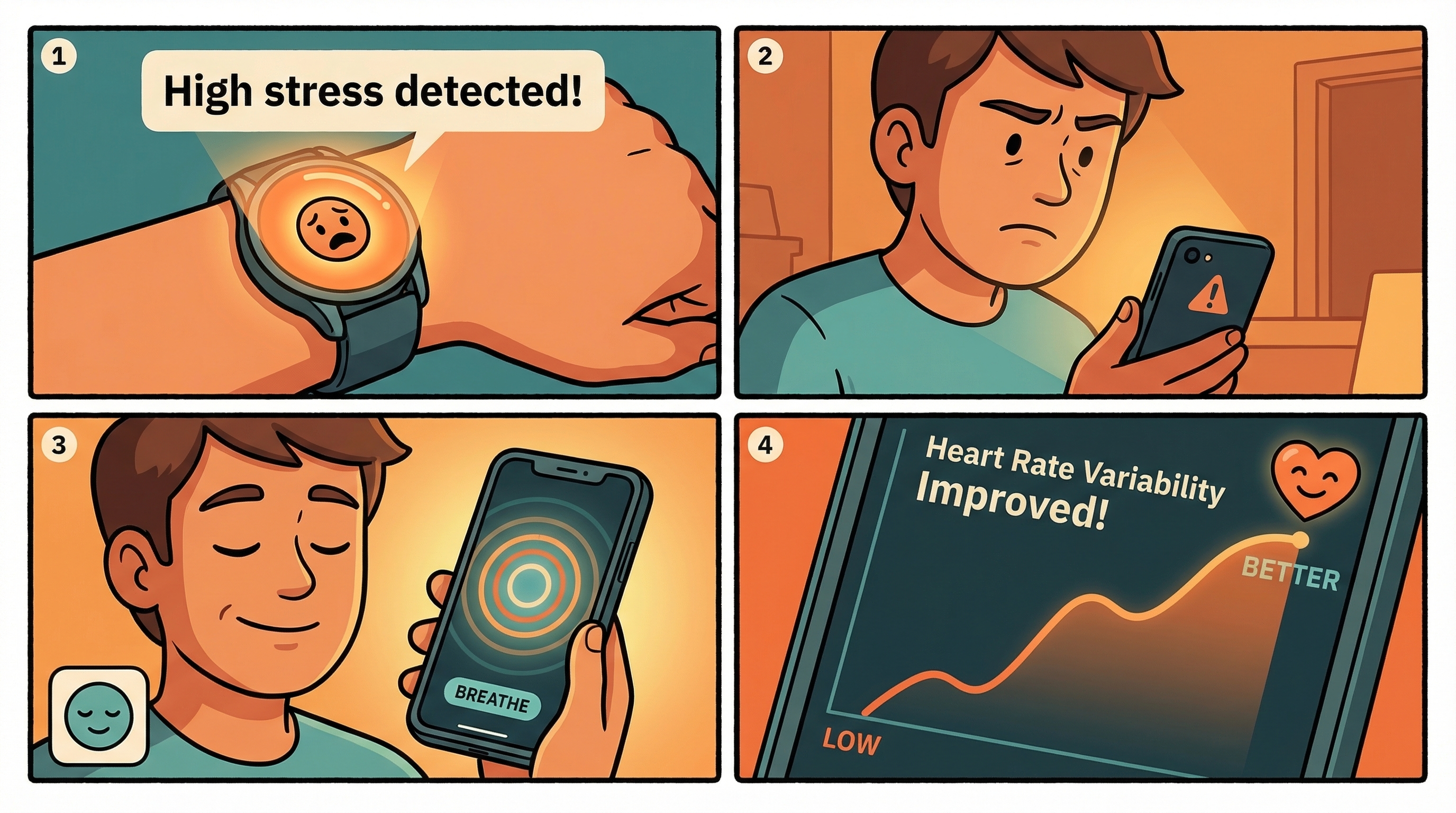
It was a Tuesday afternoon. I was in back-to-back meetings, hadn't eaten since morning, and my Apple Watch tapped me on the wrist.
Try this technique in Vayu, free download
Haptic guidance on Apple Watch and Wear OS. Your first session is free.
A notification: "Your heart rate has been elevated. Take a moment to breathe."
A moment to breathe. There was literally a button that said "Breathe." I tapped it. It showed me a circle expanding and contracting. Inhale. Exhale. One minute. Done.
My heart rate came down a few beats. The notification went away. And then nothing. No data. No feedback on whether it worked. No protocol adjusted to how dysregulated I actually was. No integration with the HRV data my watch was already collecting.
Apple Watch had diagnosed my stress and offered me a gif. That's the state of the art in consumer stress management.
The Diagnosis-to-Action Gap
The gap between knowing you're stressed and doing something effective about it is one of the most underappreciated problems in health tech. We've built extraordinary tools for the diagnosis side. Wearables can tell you your stress levels, your HRV trends, your cortisol proxies, and your readiness scores with remarkable precision.
Then they hand you a pamphlet. Or a gif. Or a generic guided meditation recorded six months ago that has no idea what your HRV was three minutes ago.
This isn't a willpower problem. It's not that people see the stress notification and choose to ignore it. It's that the notification doesn't connect to a meaningful intervention. There's nowhere to go after "your heart rate is elevated" that actually addresses the elevated heart rate.
The diagnosis happened. The treatment never shipped.
Why Generic Content Doesn't Work
Here's what makes HRV biofeedback fundamentally different from guided meditation content: it adapts to your actual physiological state in real time. The protocol changes based on what your body is doing right now. The feedback loop is your own HRV data responding to the breathing technique in the moment.
Generic meditation content is the equivalent of giving every patient the same dose of the same medication. It might help some people some of the time. But it can't target your specific autonomic state right now and calibrate the intervention accordingly.
Research on HRV biofeedback consistently shows effects that passive content can't match. The mechanism (deliberately driving your heart rate variability upward through breath-controlled vagal activation) creates a neurological learning process. Over time, the window of coherence widens. Your baseline HRV improves. Your stress response itself changes.
But this requires real-time data integration. The breathing protocol has to be connected to the biometric signal. That's not how any mainstream wellness app is built today.
The Bridge That's Missing
The hardware is there. Apple Watch and WearOS devices collect continuous HRV data. The sensors are accurate enough to drive clinical-grade biofeedback. The wrist computer that could deliver a real intervention has been in half a billion hands for years.
What's been missing is a software layer that takes the live HRV signal, assesses autonomic state, and delivers a haptic-guided, adaptive breathwork protocol that closes the loop in real time. Not a content library. Not a score. A live, responsive intervention tied to your physiology.
That's what Vayu does.
When you open Vayu, it reads your HRV. It delivers a haptic-guided pranayama session calibrated to your current state. You watch your HRV number move in real time as you breathe, rising as your vagal tone increases, showing you the intervention working at the moment you're doing it. After the session, you can see exactly where you started and where you ended.
The notification that says "you're stressed" is finally connected to something that actually does something about it.
Download Vayu and turn your wearable's data into a real intervention. Not a gif. Not a score. An actual shift.
Practice These Techniques with Vayu
Haptic breathing guidance on Apple Watch and Wear OS, paced on your wrist so you do not need the screen. Developed with the SFU Metacreation Lab, supported by NRC IRAP. Your first session is free.
Continue Reading

Breathing Exercises for Long COVID Recovery: What the Evidence Actually Shows
Do breathing exercises help long COVID recovery? A well-cited, honest look at the 2025 meta-analysis of 37 trials, what improved, and what didn't.
Jul 12, 2026

Does HRV Biofeedback Work for Anxiety and Depression? What the Science Shows
Does HRV biofeedback work for anxiety and depression? Meta-analyses show small-to-medium effects on depression, but not stress. Here is the honest evidence.
Jul 12, 2026

What 50,000 Users Taught Us About Breathing Practice
Original retention, adherence, and HRV data from 50,000+ Vayu users. What actually keeps people breathing daily, with the unflattering numbers included.
Jul 12, 2026