How Breathing Affects Blood Pressure and Heart Health


Updated September 2026 · ~8 min read
Can breathing exercises lower blood pressure? Yes. Slow breathing is one of the few non-drug interventions with randomized-trial evidence behind it. A 2019 meta-analysis in Complementary Therapies in Medicine found slow-breathing practice reduced systolic blood pressure by roughly 5 to 8 mmHg in trials, and a 2021 sham-controlled RCT in the Journal of the American Heart Association (Craighead et al.) found that five minutes a day of inspiratory muscle strength training cut systolic pressure by about 9 mmHg in six weeks. The mechanism is well mapped: breathing at around six breaths per minute increases baroreflex sensitivity and shifts the autonomic nervous system toward vagal (parasympathetic) dominance.
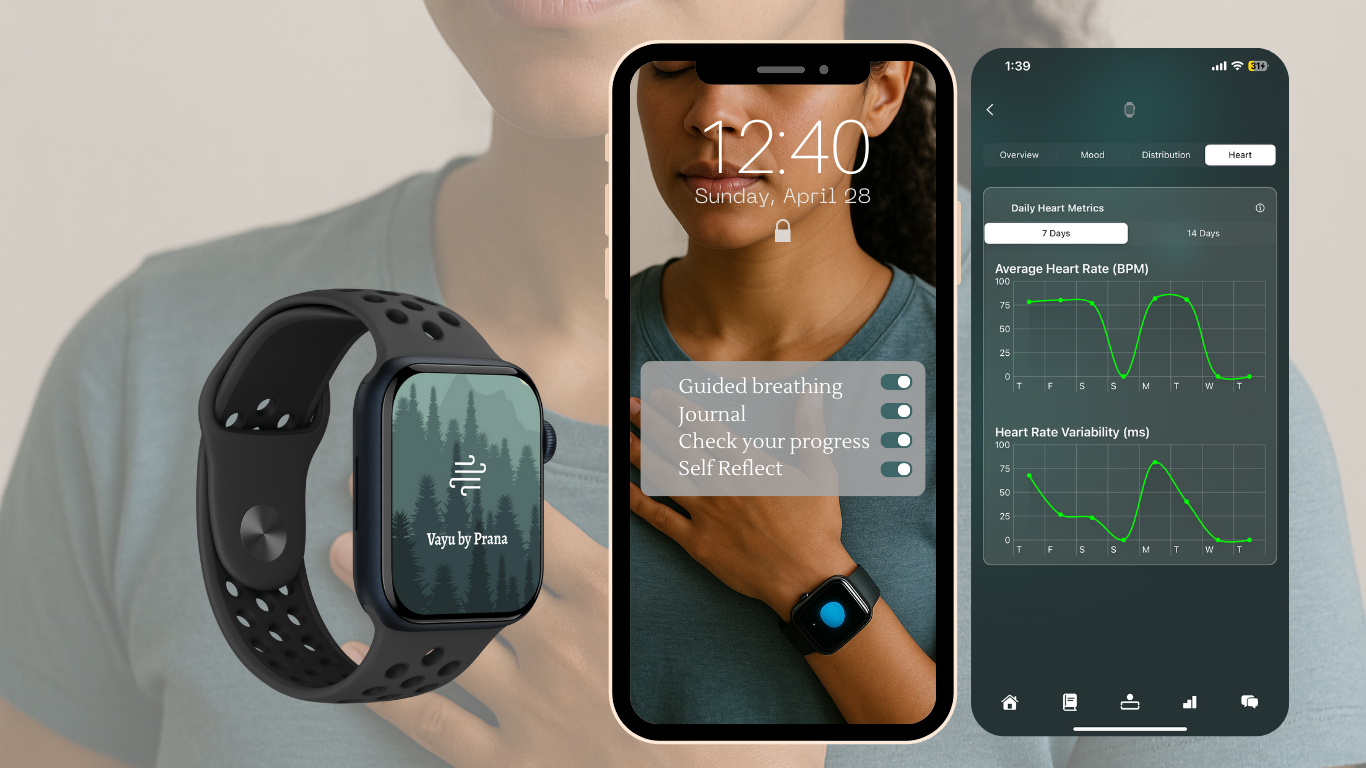
Try this technique in Vayu, free download
Haptic guidance on Apple Watch and Wear OS. Your first session is free.
For context, 5 to 9 mmHg is in the territory of a low-dose antihypertensive medication. Breathing is not a replacement for one. But the size of the effect, for five to ten minutes a day, is why cardiologists have started paying attention. One caveat up front: some of the most-cited numbers are acute, measured inside a single session, and they do not all hold up over months. We will be specific about which is which.
Before you start: who should be careful
Slow breathing is gentle, but intensive breathing exercises (fast breathing, long breath holds, resisted breathing) are not for everyone. Check with your clinician first if you have uncontrolled hypertension, have had a recent cardiac event or procedure, are pregnant, or take medication that affects heart rate or blood pressure.
Never stop or reduce prescribed medication because a breathing session lowered a cuff reading. See who should not do breathing exercises for the full list, and consult your clinician if you are unsure.
Why does breathing affect blood pressure at all?
Your breath is the only autonomic function you can directly steer, and it is wired into the same control circuits that set blood pressure.
The key player is the baroreflex, the pressure sensors in the carotid arteries and aorta that continuously nudge heart rate and vessel tone to keep blood pressure stable. In hypertension, baroreflex sensitivity is typically blunted: the thermostat goes sluggish.
Slow breathing sharpens it, at least in the moment. In a study published in Hypertension (an American Heart Association journal), Joseph et al. (2005), N=20 patients with essential hypertension breathed at 6 breaths per minute versus their usual rate. Within a single session, slow breathing lowered systolic blood pressure from 149.7 to 141.1 mmHg (P<0.05) and roughly doubled baroreflex sensitivity, while reducing sympathetic (fight-or-flight) activity. That is a real, measurable shift. The honest asterisk: it was recorded acutely, during the session itself, in a small sample, so it tells you the reflex can be moved, not that a morning of breathing resets your pressure for the day.
Three linked mechanisms, in plain terms:
- Vagal activation. Long, slow exhales stimulate the vagus nerve, slowing heart rate and dilating vessels.
- Baroreflex re-sensitization. Breathing near six breaths per minute synchronizes blood-pressure oscillations with the breath, retraining the reflex while you are doing it.
- Reduced sympathetic drive. Less fight-or-flight signaling means less vasoconstriction.
This is the same physiology behind heart rate variability. Slow breathing maximizes HRV at the so-called resonance frequency, which is why resonance frequency breathing and coherent breathing both center on roughly six breaths per minute.
How much can slow breathing lower blood pressure?
Here is what the controlled-trial literature shows, including the parts that cut against the headline:
| Intervention | BP reduction | Source |
|---|---|---|
| Non-device-guided slow breathing | 8.5 mmHg systolic / 6.9 mmHg diastolic | Chaddha et al., 2019 meta-analysis, Complementary Therapies in Medicine |
| Device-guided slow breathing | 5.3 mmHg systolic / 2.7 mmHg diastolic | Same meta-analysis |
| Device-guided slow breathing (larger 2022 re-analysis) | 2.1 mmHg systolic, not statistically significant (95% CI, 12.7 lower to 8.4 higher) | Li et al., 2022 meta-analysis |
| Inspiratory muscle strength training (IMST), 5 min/day, 6 weeks | 9 mmHg systolic (135 to 126) | Craighead et al., 2021, JAHA |
| Single session at 6 breaths/min (acute) | 149.7 to 141.1 mmHg systolic in hypertensives | Joseph et al., 2005, Hypertension |
Three honest observations from that table.
First, the evidence is genuinely mixed for breathing devices. The 2019 meta-analysis found significant reductions. A larger 2022 meta-analysis (22 studies, more than 17,000 participants) found device-guided slow breathing did not significantly beat usual care, with wide confidence intervals and high heterogeneity. Trial quality varies, protocols differ, and adherence is often poorly tracked. Anyone telling you the slow-breathing blood-pressure literature is settled has not read it.
Second, the guideline position is favorable but contested. In a 2013 AHA Scientific Statement, Brook, Appel et al. reviewed alternative approaches to lowering blood pressure and gave device-guided slow breathing a Class IIa, Level of Evidence B recommendation, meaning it is "reasonable to consider" as an adjunct. That is a genuine nod from a major body. It is also contested: the underlying trials are small and heterogeneous, the more recent meta-analytic picture (above) is weaker, and some later guidance has softened or dropped the endorsement. A IIa is not a green light to skip your medication; it is a "worth trying alongside" rating with real dissent behind it.
Third, the strongest recent result is not slow breathing at all. Craighead et al. (2021) tested inspiratory muscle strength training, 30 forceful breaths daily against resistance, in a double-blind, sham-controlled RCT of adults aged 50 to 79 with above-normal systolic pressure. Six weeks produced a roughly 9 mmHg systolic drop plus improved endothelial function and nitric-oxide bioavailability, with about 95% adherence. It is a small trial, but the design (sham control, physiological endpoints) is unusually rigorous for this field.

What does breathing do for heart health beyond blood pressure?
Blood pressure is the most-studied endpoint, but the cardiovascular case is broader:
- Heart rate variability. Higher HRV is associated with better cardiovascular outcomes, and paced slow breathing is the most reliable acute way to raise it. Association is not causation, though: raising HRV via breathing has not been proven to reduce cardiac events. See how to improve HRV with breathing.
- Baroreflex function in heart failure. Bernardi's group (Circulation, 2002) showed slow breathing acutely improves baroreflex sensitivity and oxygen saturation in chronic heart failure patients.
- Endothelial function. The Craighead IMST trial found improved flow-mediated dilation, a healthier artery lining, alongside the blood-pressure drop.
- Stress physiology. Chronic sympathetic overdrive is a cardiovascular risk pathway, and breathwork's stress effects (small-to-medium in the Fincham et al. 2023 meta-analysis) plausibly help, though no trial has followed breathwork through to heart attacks or strokes.
Where the evidence is thin
This is the part that matters most if you are deciding whether to rely on breathing.
- The best numbers are acute. The Joseph et al. (2005) drop from 149.7 to 141.1 mmHg and the doubled baroreflex sensitivity were measured within a single session, in 20 patients. They show what the reflex can do in the moment, not a durable resetting of resting blood pressure, and small trials overstate effects more often than they understate them.
- The gains may not persist. Follow-up work has found that baroreflex sensitivity improvements from slow breathing did not hold up at 3 months. The acute effect is well documented; the long-term effect is much less certain and may fade without continued practice.
- The device literature is inconsistent, and the guideline is contested. A well-powered 2022 meta-analysis was null for device-guided breathing, and the AHA's Class IIa recommendation has weakened in some later guidance. Treat "reasonable to consider" as encouragement to try, not proof it works for you.
- No hard-outcome trials exist. No study has followed breathing practice through to strokes, heart attacks, or deaths. Everything here is surrogate endpoints (blood pressure, HRV, baroreflex, endothelial function), which correlate with outcomes but are not the same thing.
Safety, stated plainly. Slow breathing is an adjunct, never a replacement for prescribed antihypertensive medication. If you have hypertension, keep taking your medication exactly as prescribed and talk to your doctor before changing anything. Do not stop or reduce a drug because a breathing session lowered your cuff reading. If you have a heart condition, are pregnant, or feel dizzy during practice, check with your physician first, and avoid breath-hold-heavy practices if your hypertension is uncontrolled.

How do you practice slow breathing for blood pressure?
The protocols that produced the trial results above are simple:
- Rate. Slow to about 6 breaths per minute, roughly a 4-second inhale and a 6-second exhale. (Coherent breathing walks through the pacing.)
- Exhale longer than you inhale. The exhale is when vagal activity peaks; diaphragmatic form (belly, not chest) helps.
- Duration. Trials used 10 to 15 minutes daily for slow breathing; the IMST protocol was 5 minutes of resisted breaths.
- Timeline. Acute blood-pressure dips appear in a single session; any sustained reductions in trials took 6 to 9 weeks of daily practice, and even then may not fully persist.
- Measure. A home cuff, taken at the same time each day, is how you find out whether your pressure responds. Vayu paces the six-breaths-per-minute protocol with silent haptic pacing on the wrist and reads your Apple Watch HRV after each session, so the trend is visible rather than guessed. It runs on Apple Watch (Series 6 or later, SE, Ultra) and Wear OS 3+ smartwatches, not Oura, Whoop, or Fitbit.
FAQ
Can deep breathing really lower blood pressure?
Yes, modestly. Meta-analyzed trials of slow breathing show systolic reductions of roughly 5 to 8 mmHg, and a 2021 sham-controlled RCT of inspiratory muscle training (Craighead et al., JAHA) found about 9 mmHg in six weeks. A 2022 meta-analysis of device-guided breathing was null, so the evidence is positive but not unanimous. It is an adjunct to prescribed treatment, not a substitute.
How long do you need to breathe slowly to lower blood pressure?
Acutely, blood pressure can drop within minutes at six breaths per minute. In Joseph et al. (2005) it fell from 149.7 to 141.1 mmHg inside one session. For any lasting change, trials used 5 to 15 minutes daily for six to nine weeks, and even those gains may not fully persist.
What is the best breathing rate for blood pressure?
About six breaths per minute, the rate shown by Joseph et al. (2005, Hypertension, N=20) to roughly double baroreflex sensitivity and acutely lower pressure in hypertensive patients.
Is breathing as effective as blood pressure medication?
No, and it has not been tested that way. The trial effect sizes (5 to 9 mmHg systolic) overlap with low-dose monotherapy, but breathing has not been tested against medication head-to-head or on outcomes like stroke, and the AHA gives it only a contested Class IIa "reasonable to consider" rating. Treat it as a complement to, never a replacement for, prescribed treatment, and keep taking your meds.
Does slow breathing help heart health if my blood pressure is normal?
Evidence suggests benefits to HRV, baroreflex sensitivity, and stress physiology even in people with normal pressure, though hard-outcome data (fewer cardiac events) does not exist yet.
Trying it
The entry point is free: slow to about six breaths per minute, exhale a little longer than you inhale, and measure with a home cuff at the same time each day for a few weeks to see whether your own pressure responds. A guided practice mostly saves you from counting. Keep it next to your medication, not in place of it.
Sources
- Joseph, C.N., et al. (2005). Slow breathing improves arterial baroreflex sensitivity and decreases blood pressure in essential hypertension. Hypertension, 46(4), 714 to 718. PMID 16129818.
- Brook, R.D., Appel, L.J., et al. (2013). Beyond medications and diet: alternative approaches to lowering blood pressure. A scientific statement from the American Heart Association. Hypertension, 61(6), 1360 to 1383. (Device-guided slow breathing: Class IIa, Level of Evidence B.)
- Craighead, D.H., et al. (2021). Time-efficient inspiratory muscle strength training lowers blood pressure and improves endothelial function. Journal of the American Heart Association, 10(13), e020980.
- Chaddha, A., et al. (2019). Device and non-device-guided slow breathing to reduce blood pressure: a systematic review and meta-analysis. Complementary Therapies in Medicine, 45, 179 to 184.
- Li, et al. (2022). Device and nondevice-guided slow breathing to reduce blood pressure in hypertensive patients: a systematic review and meta-analysis.
- Bernardi, L., et al. (2002). Slow breathing increases arterial baroreflex sensitivity in patients with chronic heart failure. Circulation, 105(2), 143 to 145.
- Fincham, G.W., et al. (2023). Effect of breathwork on stress and mental health: a meta-analysis of randomised-controlled trials. Scientific Reports, 13, 432.
This article is for informational purposes and is not medical advice. Never adjust blood pressure medication without consulting your physician.
Practice These Techniques with Vayu
Haptic breathing guidance on Apple Watch and Wear OS, paced on your wrist so you do not need the screen. Developed with the SFU Metacreation Lab, supported by NRC IRAP. Your first session is free.
Continue Reading
Boost Your Health Naturally: Combining Fasting with Breathing Techniques
In our busy modern lives, many of us are seeking simple yet powerful ways to boost our health, clear our minds, and reconnect spiritually. Interestingly, two ancient practices—fasting and pranayama (breathing exercises)—can offer these benefits, especially when combined. Techniques like Bhastrika, Anulom Vilom, and Kapalbhati have been practiced for centuries, and integrating them with fasting can significantly amplify their effects on your body and mind.
Apr 17, 2025

The Three-Minute Window: Breathing for Faster Exercise Recovery
Heart rate recovery is one of the most useful markers in training. What slow breathing between sets actually does, what it does not do, and why hands on knees beats hands on head.
Sep 15, 2026

Nasal vs Mouth Breathing: Does It Actually Matter?
Is nasal breathing better than mouth breathing? The honest, study-by-study answer on nitric oxide, exercise, and sleep, including where the evidence is thin.
Jul 12, 2026