Teaching Kids to Breathe: What Actually Works, by Age
Telling an upset six-year-old to take a deep breath is, in most cases, a way of making an upset six-year-old angrier.
Try this technique in Vayu, free download
Haptic guidance on Apple Watch and Wear OS. Your first session is free.
Not because the advice is wrong, but because it arrives at the wrong moment, in the wrong form, aimed at a brain that is not currently able to use it.
Breathing regulation genuinely helps children. It just has to be taught the way children actually learn things: through play, before the crisis, at a developmental level that matches the child in front of you.
Why "Take a Deep Breath" Fails
Three reasons, and each points to a fix.
1. The instruction is abstract. "Deep breath" is a concept. Young children reason in concrete, physical terms. "Make the feather move without blowing it off the table" is an instruction a four-year-old can follow. "Breathe deeply" is not.
2. The timing is backwards. During a full emotional escalation, the prefrontal cortex, which handles deliberate self-regulation, is functionally offline. Asking a child to execute a novel cognitive strategy at peak distress asks for something their nervous system cannot currently deliver. Skills must be installed when calm and retrieved when not.
3. Deep often becomes fast. Told to breathe deeply, most children produce big, rapid, upper-chest breaths. That is closer to hyperventilation than to calming, and it can make them feel dizzy and more distressed, teaching them that breathing exercises make things worse.
The reframe that fixes all three: you are not teaching a technique, you are building a reflex. Reflexes are built by repetition in calm conditions, in a form the child finds fun enough to repeat.

What the Research Shows
The evidence base for children is smaller than for adults, and worth describing accurately.
Slow breathing and mindfulness-based programmes delivered in schools show modest but real benefits for anxiety symptoms and emotional regulation. A 2019 meta-analysis of school-based mindfulness interventions found small to moderate effects on stress and anxiety outcomes, with the strongest results in programmes that ran for several weeks rather than as one-off sessions.
Two honest caveats. First, most of these programmes bundle breathing with other components, so isolating the breathing effect is difficult. Second, effect sizes are generally modest, and a few trials found no benefit. The realistic claim is that breathing practice is a useful, low-risk skill that helps many children somewhat, not a transformative intervention.
What is better established is the physiology underneath: extended exhalation increases vagal tone and slows heart rate in children as it does in adults. The mechanism is sound. The variability lies in whether a given child will actually use it.
By Age: What Actually Works
Ages 3 to 5: pure play, no explanation
At this age, skip the reasoning entirely. Do not explain the nervous system. Make it a game you play together.
- Bubble breathing. Real bubbles, real wand. Blowing a big bubble requires a slow, steady, controlled exhale. Blow too hard and it pops. This is a perfect exhale trainer disguised as a toy, and the feedback is immediate and visible.
- Feather or tissue on the table. Move it slowly across the surface without blowing it off the edge.
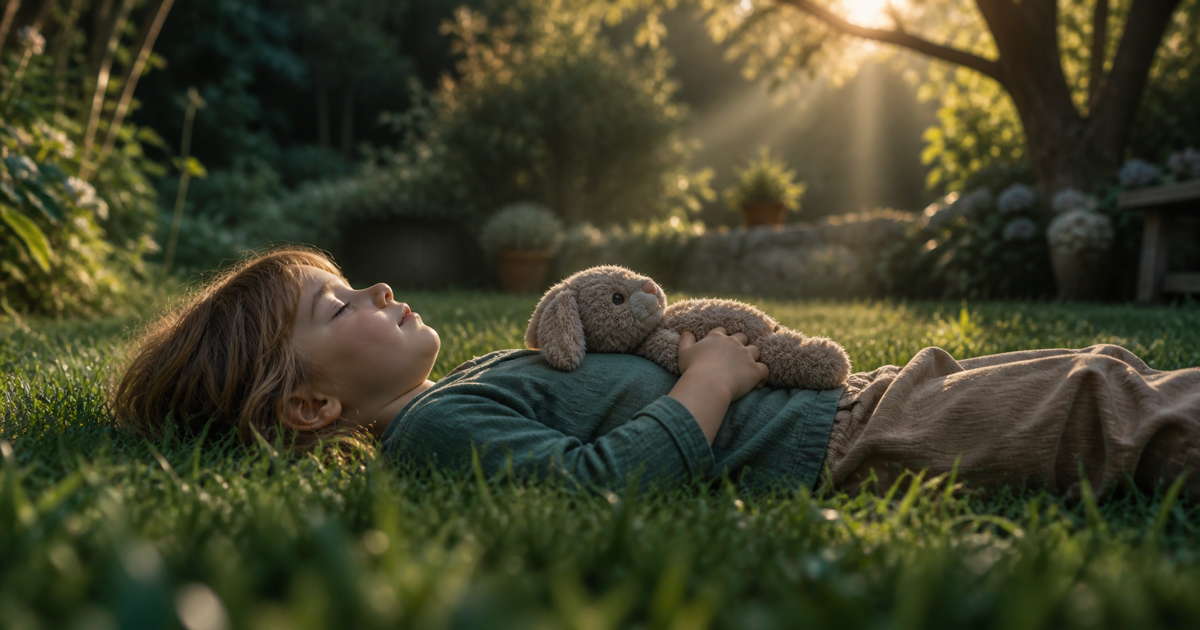
- Stuffed animal belly ride. Child lies on their back with a small stuffed toy on their belly. The job is to rock the animal gently to sleep using only their breathing. This teaches diaphragmatic breathing without the word diaphragm.
- Smell the flower, blow the candle. Hands as props: one is a flower to sniff, the other a candle to blow out slowly. Simple, portable, and it naturally produces a longer exhale than inhale.
Ages 6 to 9: shape and counting
Children this age can follow a pattern and enjoy having a name for it.
- Finger tracing. Spread one hand. Use the index finger of the other to trace up one finger while breathing in, and down while breathing out. Five fingers, five breaths. It gives the hands something to do, which helps enormously.
- Square breathing, drawn. Trace a square in the air or on paper: in for 4 up the side, hold for 4 across the top, out for 4 down, hold for 4 back. Keep counts at 3 or 4, not the adult 4-4-4-4 at full length.
- Snake breath. Inhale through the nose, then exhale with a long quiet hiss for as long as comfortable. Children naturally extend the exhale when it makes a sound, which is exactly the goal.
- Hot cocoa breath. Smell the cocoa, then cool it slowly. Same structure as flower and candle, with better seasonal appeal.
Ages 10 and up: give them the reason
Older children and teenagers respond well to knowing why, and often resist anything that feels babyish.
- Explain the actual mechanism. Tell them that a long exhale sends a signal along the vagus nerve that slows the heart, and that this is measurable. Teenagers are far more willing to use a tool that has a real mechanism than one that sounds like a mood trick.
- Extended exhale, 4 in and 6 to 8 out. Straightforward and effective.
- Let them measure it. Have them take their pulse, do three minutes of slow breathing, and take it again. Personal evidence beats instruction at this age.
- Link it to something they care about. Before a test, before a penalty kick, before a performance, before a difficult conversation. Utility, not wellness.

The Part Most Guides Skip: Co-Regulation
Young children do not primarily calm themselves. They calm by borrowing the regulated state of a nearby adult, a process called co-regulation.
The practical implication is uncomfortable but useful: your own breathing during your child's meltdown matters more than your instructions. A calm, slow-breathing adult is itself the intervention. A tense adult instructing a child to relax is sending two contradictory signals, and children read the nervous system, not the sentence.
So the sequence that works during an actual meltdown is:
- Regulate yourself first. Slow your own breathing. Drop your voice in volume and pitch.
- Get close and reduce demands. Fewer words, not more. Stop instructing.
- Breathe audibly near them, without asking them to copy you. Many children spontaneously match the rhythm within a minute or two.
- Only afterwards, name what happened. The teaching moment is after the storm, not during it.
Tips & Common Mistakes
Tips:
- Practise daily when calm, in tiny doses. Two minutes at bedtime, every night, builds a retrievable skill. Practising only during distress guarantees it fails.
- Use props for as long as they help. Bubbles, pinwheels, feathers, and stuffed animals give abstract instructions a physical form.
- Let them lead sometimes. Children who get to be the one guiding a parent through the exercise engage far more than children who are always the subject of it.
- Name the feeling, not the failure. "Your body got really big feelings" lands better than "you need to calm down."
Common Mistakes:
- Introducing it first during a tantrum. Guaranteed to fail, and it teaches the child that breathing exercises are a thing adults impose when they are annoyed.
- Using it as a consequence or a sanction. "Go breathe" as a punishment poisons the tool permanently.
- Counts that are too long. Adult ratios are uncomfortable for small lungs. Shorten everything.
- Forcing it on a child who refuses. Pressure creates resistance. Do it yourself nearby and let curiosity do the work.
- Breath holds for young children. Skip holds entirely under about age 8, and keep them very short after that. The benefit is in the slow exhale, not the hold.
When to Seek Help
Breathing games support everyday emotional regulation. They are not a treatment for a clinical anxiety disorder. Talk to a paediatrician or child psychologist if your child shows persistent anxiety that interferes with school, friendships, sleep, or eating; panic symptoms; refusal to attend school; or regression in previously established skills. Childhood anxiety disorders respond well to proper treatment, and early help works better than waiting.
Also see a clinician for the physical side if your child habitually mouth breathes, snores regularly, or seems chronically congested. These are worth assessing on their own terms.
How Vayu Helps
Vayu is built for adults, and the most useful thing it does for a family is regulate the parent. Co-regulation means your steadiness is the tool your young child actually uses, and a short guided session before a predictably hard part of the day, the school run, bedtime, the witching hour before dinner, puts you in a better state to be that anchor.
For older children and teenagers who want to try slow breathing with a real cue, the haptic pacing gives them something to follow that is not a screen and not a parent counting at them, which for a thirteen-year-old is a meaningful distinction.
Download Vayu on iOS or Android →
FAQ
Q: At what age can a child learn breathing exercises? From about age three, provided it is framed as play rather than instruction. Bubbles, pinwheels, and moving a feather across a table all teach controlled exhalation without requiring any abstract understanding. Around six, children can follow simple patterns like tracing fingers or drawing a square. From ten or so, explaining the actual mechanism tends to increase buy-in considerably.
Q: Why does my child refuse to breathe when they are upset? Because at peak distress the brain regions responsible for deliberate self-regulation are largely unavailable, so you are asking for something they cannot currently do. Skills need to be practised when calm so they can be retrieved later. During an actual meltdown, the more effective approach is co-regulation: slow your own breathing, reduce your words, and stay close, since young children calm by borrowing a regulated adult's state rather than generating their own.
Q: How long should kids practise breathing exercises? Much shorter than adults. One to three minutes is plenty for most children, and daily consistency matters far more than duration. Two minutes at bedtime every night builds a more reliable skill than a ten-minute session once a week. Keep counts short, since adult ratios like a four-second hold are uncomfortable for smaller lungs, and avoid breath holds altogether for children under about eight.
Practice These Techniques with Vayu
Haptic breathing guidance on Apple Watch and Wear OS, paced on your wrist so you do not need the screen. Developed with the SFU Metacreation Lab, supported by NRC IRAP. Your first session is free.
Continue Reading

The Three-Minute Window: Breathing for Faster Exercise Recovery
Heart rate recovery is one of the most useful markers in training. What slow breathing between sets actually does, what it does not do, and why hands on knees beats hands on head.
Sep 15, 2026

Sleep Apnea and Breathwork: What Helps, What Is Hype
Myofunctional therapy cuts apnea severity by about half. That is real, and it is not a cure. An honest look at where breathing exercises fit, and where they are dangerous to rely on.
Sep 15, 2026

The Breath Before You Speak: Voice, Nerves, and the Long Exhale
Why a big deep breath makes stage fright worse, and what to do instead. The breathing that steadies your nervous system is the same breathing that supports your voice.
Sep 15, 2026