Waking Up at 3am? Why It Happens and How to Fall Back Asleep

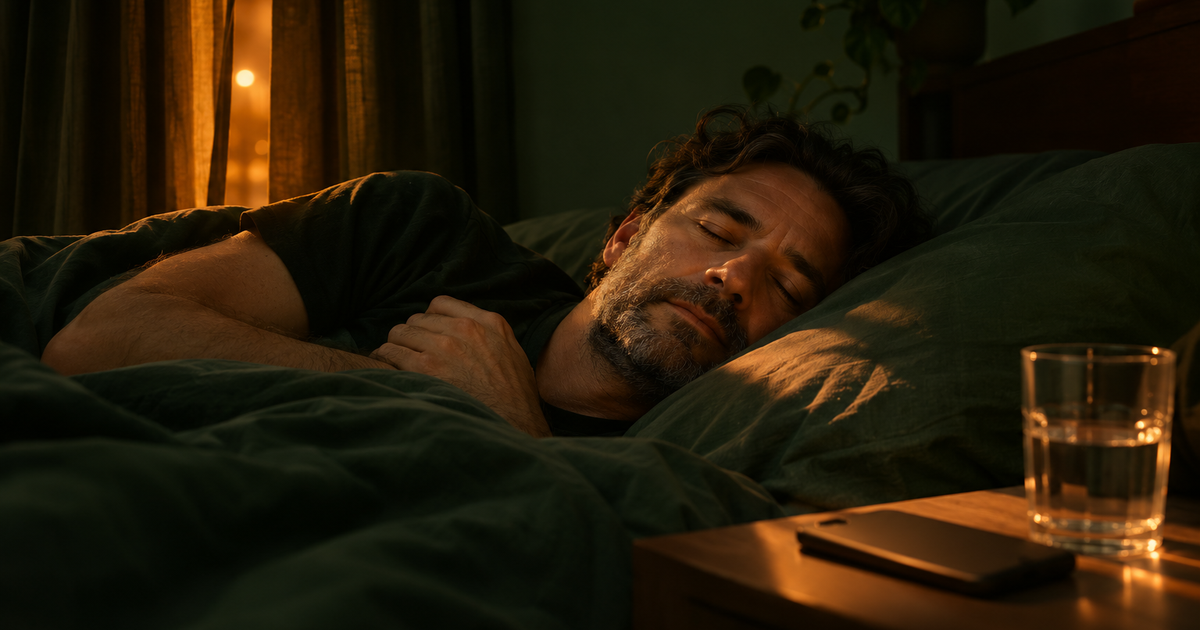
Waking at 3 a.m. usually starts as one of the brief wakings that happen between sleep cycles. By then most of your deep sleep is behind you and cortisol is climbing toward morning, so alcohol, a full bladder, apnea or worry can stretch it into an hour awake. What helps: leave the clock alone, breathe slowly with a long exhale, and get up if frustration builds.
Try this technique in Vayu, free download
Haptic guidance on Apple Watch and Wear OS. Your first session is free.
This is a different problem from lying awake at bedtime, which we cover in breathing exercises for sleep, and it is common. In a survey of 8,937 American adults, 35.5% woke in the night at least three nights a week (Ohayon, 2008). In a European survey of 22,740 people, 16.1% struggled to get back to sleep three or more nights a week, and on average it had lasted 40 months (Ohayon, 2009).
The honest summary: the best evidence for what to do at 3 a.m. comes from cognitive behavioral therapy for insomnia (CBT-I). Breathing studies are few, small and nearly all done at bedtime, so the plan below follows CBT-I's rules and gives breathing a modest job: handing an alert brain something slow and dull to hold.
Why do you wake up at 3 a.m.?
Your sleep is lighter by then
Sleep runs in cycles of roughly 90 to 110 minutes. Deep slow-wave sleep is packed into the first half of the night, and the second half is lighter, with longer REM periods (Kabrita et al., 2026). Healthy adults wake about five times a night between cycles and forget most of it: in one study of 39 adults, it took about four minutes awake, on average, to remember a waking the next morning (Winser et al., 2013). The waking is normal. The trouble is whatever keeps you up long enough to notice.
Cortisol is already rising
Cortisol bottoms out near midnight, starts rising two to three hours after you fall asleep, and keeps climbing into the morning (Hirotsu et al., 2015). That rise is gradual. But by 3 a.m. the deep-sleep pressure that held you down at midnight is spent and your waking systems are warming up, so a smaller nudge brings you to the surface.
The alcohol rebound
A review of the research in healthy volunteers found that at every dose, alcohol helps you fall asleep, consolidates the first half of the night and disrupts the second half (Ebrahim et al., 2013). If your 3 a.m. wakings cluster after evenings you drank, start there.
Your bladder
Across 43 community studies, up to one in five or six younger adults, and up to 60% of older adults, get up to urinate at least twice a night (Bosch and Weiss, 2010). Night urination is also linked to sleep apnea (Zhou et al., 2020), so bathroom trips plus snoring are worth raising with a doctor.
Sleep apnea, the cause people miss
About 936 million adults aged 30 to 69 have at least mild obstructive sleep apnea (Benjafield et al., 2019). Insomnia is on its formal symptom list, next to snoring, witnessed pauses and waking with a gasping or choking feeling (Kapur et al., 2017), and 30% to 40% of people with chronic insomnia meet the criteria for apnea (Sweetman et al., 2021). In one primary care study, a quarter of 110 people taking sleep medication for chronic insomnia had undiagnosed moderate to severe sleep-disordered breathing (Hilmisson et al., 2019). Breathing events are longer and drop oxygen further in REM sleep, which is concentrated late in the night (Bonsignore et al., 2024). That puts apnea right in the 3 a.m. window. Our guide to sleep apnea and breathwork covers what helps.
The worry loop
Once you're awake, the mind fills the quiet. The leading model of chronic insomnia describes hyperarousal: raised activity in the nervous system, stress hormones and brain, kept going by worry and by a learned link between bed and being awake (Riemann et al., 2010). At 3 a.m. nothing else competes for your attention, so a passing thought about work can turn into twenty minutes of planning.
Age and hormones
With age, deep sleep shrinks and time awake in the night grows (Ohayon et al., 2004). Older adults' body clocks also run about an hour earlier, and their sleep breaks most easily in the early morning (Dijk et al., 2000). In the menopausal transition, hot flashes are a major driver (Baker et al., 2018). See our piece on breathing and the perimenopause hot flash.
What CBT-I says to do when you wake up
Both the American Academy of Sleep Medicine (AASM) and the European insomnia guideline put CBT-I first for chronic insomnia (Edinger et al., 2021; Riemann et al., 2023). Across 20 trials and 1,162 people, it cut time awake in the night by about 26 minutes (Trauer et al., 2015).
Which parts do the work? A 2024 analysis of 241 trials and 31,452 people found benefits for cognitive restructuring, mindfulness-type components, sleep restriction and stimulus control. Relaxation, which includes breathing exercises, came out slightly negative (odds ratio 0.81, 95% CI 0.64 to 1.02), and the authors called it "potentially counterproductive" (Furukawa et al., 2024). Since that interval includes no effect, the fair reading is that relaxation adds nothing clear on top of the rest. The AASM still gives relaxation therapy, abdominal breathing included, a conditional recommendation, on low-quality evidence. So think of breathing as a supporting act.
The 20-minute rule
Stimulus control was written for this moment. The AASM version: go to bed only when sleepy, get out of bed when you can't sleep, keep the bed for sleep and sex, wake at the same time every morning, and skip naps. Clinical guides set the threshold at about 15 to 20 minutes (RACGP). A handout from the University of Pennsylvania's CBT-I program adds two details: estimate instead of watching the clock, and leave the bed at the first sign of frustration or worry, even before 20 minutes are up. In the handout's words: "The important thing is to stop 'trying' to sleep."
Don't check the clock
In two experiments, people told to watch a clock while trying to fall asleep worried more and took longer to drop off, good sleepers included. Among 38 people with insomnia, the clock-watchers also overestimated how long they had been awake (Tang et al., 2007). The studies tested falling asleep, but the mechanism carries over: each look starts a calculation ("if I drop off now, I get three and a half hours"), and the calculation is a worry. Turn the clock to the wall. A phone adds bright light and something to read, which is why the Penn handout rules phones out during night wakings.
Why trying hard to sleep backfires
In a classic experiment, people told to fall asleep as fast as possible did so faster while listening to calm music, but slower than relaxed controls while listening to John Philip Sousa marches (Ansfield et al., 1996). Under mental load, effort got in the way. In 62 older adults doing online CBT-I, a drop in sleep effort was the only one of six measured factors that explained their improvement (Kutzer et al., 2024; no control group). So don't use each breath as a lever to force sleep. Use breathing as something slow and boring for your attention while sleep returns on its own schedule.
What the evidence says about slow breathing at night
People with insomnia show lower vagal activity in their heart rate variability (Tsai et al., 2015), and breathing near six breaths a minute, with the exhale slightly longer than the inhale, is a standard way to raise it (Laborde et al., 2019). Whether that carries through to sleep is the open question.
- Paced breathing in insomnia (Tsai et al., 2015). Fourteen people with self-reported insomnia did 20 minutes of breathing at six a minute (3 seconds in, 7 out) before bed. In the sleep lab they fell asleep faster, woke fewer times and spent less time awake than at baseline or after breathing at 12 a minute. It's the only study here that measured night wakings: one night, one lab.
- Thirty evenings of slow breathing (Laborde et al., 2019). Sixty-four healthy students were randomized to 15 minutes of app-paced breathing (4.5 seconds in, 5.5 out) or social media each evening. Breathing improved sleep quality, but in good sleepers: the average score moved from 3.31 to 2.91 on a 21-point scale.
- 4-7-8 breathing (Kirazli et al., 2026). In 48 people with tinnitus, six weeks of 4-7-8, four cycles twice a day, cut Insomnia Severity Index scores from 8.4 to 4.4, versus no change with an information session alone. But the controls did nothing comparable, and people who skipped practice were excluded.
- Cyclic sighing (Balban et al., 2023). Five minutes a day improved mood more than mindfulness meditation in 108 people, but wearable-measured sleep did not change in any group. A useful check on anyone selling cyclic sighing as a sleep fix.
- A 2026 systematic review (Eide et al., 2026). Nine studies, 457 people. Self-reported sleep improved after bedtime slow breathing. Objective sleep was inconclusive.
Mindfulness, a close cousin, has better trials. In 54 adults with chronic insomnia, meditation-based programs cut total wake time by about 44 minutes, against about one minute for self-monitoring (Ong et al., 2014). Across 18 trials and 1,654 people, mindfulness beat time-matched control activities with an effect size of 0.33, but did no better than established sleep therapies (Rusch et al., 2019).
Put together: a believable mechanism, small improvements in how people rate their sleep, mixed results on measured sleep, and no trial at 3 a.m. itself. Enough to try, not enough to expect it to fix a problem that has run for months.
A breathing plan for 3 a.m.
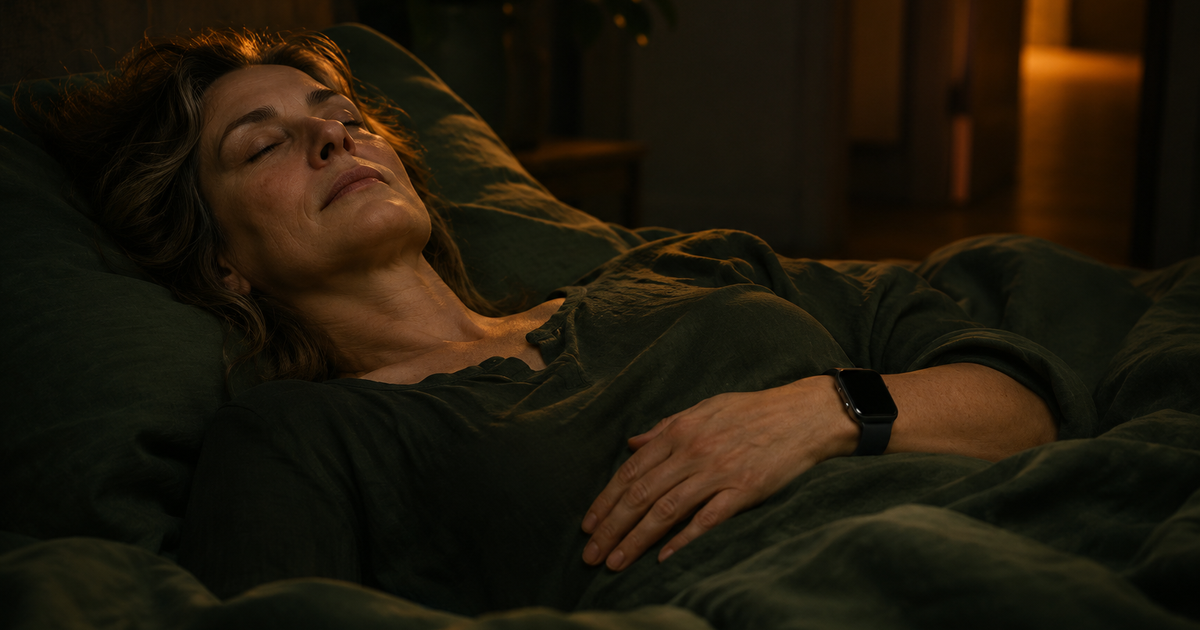
Lying in bed, lights off, eyes closed. Five to ten minutes.
- Leave the time alone. No clock, no phone. If you need the bathroom, use as little light as you can.
- Breathe through your nose in your usual sleep position. Let your jaw and shoulders go slack.
- Lengthen the exhale. In for about 4 seconds, out for about 6, stretching toward 7 or 8 if that feels easy. That's five to six breaths a minute. Keep the breaths small and quiet; slow matters more than big, and in one lab study breathing at six a minute nudged people into mild over-breathing (Marchant et al., 2025). If you feel lightheaded or tingly, take in less air.
- Count ten breaths, then start again. A round takes about two minutes. If you lose count, start over; sometimes it means you were drifting off.
- After three or four rounds, stop counting. Keep the exhale long. When thoughts arrive, notice them and come back to the air leaving your nose.
- Prefer 4-7-8? In through the nose for 4, hold for 7, out through the mouth for 8. Do four cycles, as in the tinnitus trial, then switch to plain slow breathing. Drop the hold if it makes you tense.
- Frustrated? Get up. At what feels like 20 minutes, or sooner if frustration builds, go to another room. Dim light, no screens, something dull like a paper book. Go back to bed when you feel sleepy.
- Get up at your usual time. Keep your wake time fixed and skip the long nap, so the next night starts with full sleep pressure.
Save fast techniques like kapalbhati and bhastrika for the daytime.
Safety, and when to see a doctor
Slow nasal breathing is gentle and safe for most people. If you're pregnant, have a heart or lung condition, or find breath holds make you anxious, skip the 4-7-8 hold unless your clinician says otherwise. Our safety page lists other cautions.
See a doctor if:
- It happens most nights, for months. Trouble sleeping three or more nights a week for at least three months, with an effect on your days, meets the definition of insomnia disorder (Palagini et al., 2026). Ask about CBT-I, in person or digital.
- You snore, gasp or stop breathing. The AASM counts daytime sleepiness plus any two of loud snoring, witnessed pauses or gasping, and high blood pressure as a sign of higher risk for moderate to severe apnea (Kapur et al., 2017).
- You wake early with low mood. Waking at least two hours before your usual time is a diagnostic feature of melancholic depression (Wang et al., 2021), and insomnia roughly doubles the risk of later depression (Baglioni et al., 2011). If mornings feel heavy or you've lost interest in things, talk to a doctor. If you have thoughts of harming yourself, contact emergency services or a crisis line now.
- Something else is waking you, such as hot flashes, pain, or urinating two or more times a night.
How Vayu Helps
The hard part of breathing at 3 a.m. is keeping a slow count in the dark without reaching for a screen. Vayu paces the breath with haptics. On Apple Watch or a Wear OS watch, the watch taps the rhythm on your wrist. On iPhone, the phone itself can pace the session with no watch: taps build through the inhale, thin out through the exhale and tick once a second through a hold, so you can follow it with your eyes closed (more on our haptic breathing page).
Both patterns from the plan, 4-7-8 and extended exhale, are in the app, and the average session is about two minutes, close to one round of ten slow breaths. Vayu won't fix apnea, and it's no substitute for CBT-I if this happens most nights. What it does is take the counting off your hands.
Download Vayu on iOS or Android →
FAQ
Q: Why do I wake up at 3 a.m. every night? Usually lighter sleep late in the night, the morning cortisol rise, and something that stretches a brief waking: alcohol, a full bladder, apnea or stress. Over time the brain can learn to link bed and that hour with being awake, which is what stimulus control is designed to undo.
Q: Should I get out of bed if I can't fall back asleep? Yes, once it feels like 15 to 20 minutes have passed or you notice frustration building. Go to another room, keep the light dim, do something quiet, and return when sleepy. Estimate the time instead of checking it.
Q: Does 4-7-8 breathing help you fall back asleep? No trial has tested it for middle-of-the-night waking. A small 2026 trial in people with tinnitus found insomnia scores fell after six weeks of practice, and slow, long-exhale breathing has small positive sleep studies. Worth trying; drop the hold if it makes you tense.
Q: Can waking at 3 a.m. be a sign of sleep apnea? It can. About 30% to 40% of people with chronic insomnia also meet the criteria for apnea, and apnea events are worst in REM sleep, which clusters late in the night. Snoring, gasping, witnessed pauses or daytime sleepiness are reasons to ask for a sleep study.
Sources
- Ohayon MM. (2008). Nocturnal awakenings and comorbid disorders in the American general population. Journal of Psychiatric Research, 43(1), 48-54. doi:10.1016/j.jpsychires.2008.02.001
- Ohayon MM. (2009). Difficulty in resuming or inability to resume sleep and the links to daytime impairment: definition, prevalence and comorbidity. Journal of Psychiatric Research, 43(10), 934-940. doi:10.1016/j.jpsychires.2009.01.011
- Kabrita CS, Ghanem FK, Khalil B. (2026). Physiology of Sleep. In: StatPearls. StatPearls Publishing. PubMed 29494118
- Winser MA, McBean AL, Montgomery-Downs HE. (2013). Minimum duration of actigraphy-defined nocturnal awakenings necessary for morning recall. Sleep Medicine, 14(7), 688-691. doi:10.1016/j.sleep.2013.03.018
- Hirotsu C, Tufik S, Andersen ML. (2015). Interactions between sleep, stress, and metabolism: From physiological to pathological conditions. Sleep Science, 8(3), 143-152. doi:10.1016/j.slsci.2015.09.002
- Ebrahim IO, Shapiro CM, Williams AJ, Fenwick PB. (2013). Alcohol and sleep I: effects on normal sleep. Alcoholism: Clinical and Experimental Research, 37(4), 539-549. doi:10.1111/acer.12006
- Bosch JL, Weiss JP. (2010). The prevalence and causes of nocturia. Journal of Urology, 184(2), 440-446. doi:10.1016/j.juro.2010.04.011
- Zhou J, Xia S, Li T, Liu R. (2020). Association between obstructive sleep apnea syndrome and nocturia: a meta-analysis. Sleep and Breathing, 24(4), 1293-1298. doi:10.1007/s11325-019-01981-6
- Benjafield AV, Ayas NT, Eastwood PR, et al. (2019). Estimation of the global prevalence and burden of obstructive sleep apnoea: a literature-based analysis. Lancet Respiratory Medicine, 7(8), 687-698. doi:10.1016/S2213-2600(19)30198-5
- Kapur VK, Auckley DH, Chowdhuri S, et al. (2017). Clinical Practice Guideline for Diagnostic Testing for Adult Obstructive Sleep Apnea: An American Academy of Sleep Medicine Clinical Practice Guideline. Journal of Clinical Sleep Medicine, 13(3), 479-504. doi:10.5664/jcsm.6506
- Sweetman A, Lack L, McEvoy RD, et al. (2021). Bi-directional relationships between co-morbid insomnia and sleep apnea (COMISA). Sleep Medicine Reviews, 60, 101519. doi:10.1016/j.smrv.2021.101519
- Hilmisson H, Sveinsdottir E, Lange N, Magnusdottir S. (2019). Insomnia symptoms in primary care: A prospective study focusing on prevalence of undiagnosed co-morbid sleep disordered breathing. European Journal of Internal Medicine, 63, 19-26. doi:10.1016/j.ejim.2019.01.011
- Bonsignore MR, Mazzuca E, Baiamonte P, et al. (2024). REM sleep obstructive sleep apnoea. European Respiratory Review, 33(171), 230166. doi:10.1183/16000617.0166-2023
- Riemann D, Spiegelhalder K, Feige B, et al. (2010). The hyperarousal model of insomnia: a review of the concept and its evidence. Sleep Medicine Reviews, 14(1), 19-31. doi:10.1016/j.smrv.2009.04.002
- Ohayon MM, Carskadon MA, Guilleminault C, Vitiello MV. (2004). Meta-analysis of quantitative sleep parameters from childhood to old age in healthy individuals: developing normative sleep values across the human lifespan. Sleep, 27(7), 1255-1273. doi:10.1093/sleep/27.7.1255
- Dijk DJ, Duffy JF, Czeisler CA. (2000). Contribution of circadian physiology and sleep homeostasis to age-related changes in human sleep. Chronobiology International, 17(3), 285-311. doi:10.1081/CBI-100101049
- Baker FC, de Zambotti M, Colrain IM, Bei B. (2018). Sleep problems during the menopausal transition: prevalence, impact, and management challenges. Nature and Science of Sleep, 10, 73-95. doi:10.2147/NSS.S125807
- Edinger JD, Arnedt JT, Bertisch SM, et al. (2021). Behavioral and psychological treatments for chronic insomnia disorder in adults: an American Academy of Sleep Medicine clinical practice guideline. Journal of Clinical Sleep Medicine, 17(2), 255-262. doi:10.5664/jcsm.8986
- Riemann D, Espie CA, Altena E, et al. (2023). The European Insomnia Guideline: An update on the diagnosis and treatment of insomnia 2023. Journal of Sleep Research, 32(6), e14035. doi:10.1111/jsr.14035
- Palagini L, Ellis JG, Geoffroy PA, et al. (2026). The European 2023 Guideline on diagnosing and treating insomnia disorder: A Plain Language Summary of Publication. Sage Open Chronic Disease, 17. doi:10.1177/27558428251411744
- Trauer JM, Qian MY, Doyle JS, Rajaratnam SM, Cunnington D. (2015). Cognitive Behavioral Therapy for Chronic Insomnia: A Systematic Review and Meta-analysis. Annals of Internal Medicine, 163(3), 191-204. doi:10.7326/M14-2841
- Furukawa Y, Sakata M, Yamamoto R, et al. (2024). Components and Delivery Formats of Cognitive Behavioral Therapy for Chronic Insomnia in Adults: A Systematic Review and Component Network Meta-Analysis. JAMA Psychiatry, 81(4), 357-365. doi:10.1001/jamapsychiatry.2023.5060
- Royal Australian College of General Practitioners. Resource G: GP guide to behavioural therapy for insomnia. racgp.org.au
- Findley J. Stimulus Control (patient handout). University of Pennsylvania Behavioral Sleep Medicine, CBT-I program. med.upenn.edu
- Tang NK, Schmidt DA, Harvey AG. (2007). Sleeping with the enemy: clock monitoring in the maintenance of insomnia. Journal of Behavior Therapy and Experimental Psychiatry, 38(1), 40-55. doi:10.1016/j.jbtep.2005.07.004
- Ansfield ME, Wegner DM, Bowser R. (1996). Ironic effects of sleep urgency. Behaviour Research and Therapy, 34(7), 523-531. doi:10.1016/0005-7967(96)00031-9
- Kutzer Y, Whitehead L, Quigley E, Stanley M. (2024). Changes in sleep effort mediate insomnia severity in older adults following online cognitive behavioural therapy. Psychogeriatrics, 24(2), 303-311. doi:10.1111/psyg.13074
- Tsai HJ, Kuo TB, Lee GS, Yang CC. (2015). Efficacy of paced breathing for insomnia: enhances vagal activity and improves sleep quality. Psychophysiology, 52(3), 388-396. doi:10.1111/psyp.12333
- Laborde S, Hosang T, Mosley E, Dosseville F. (2019). Influence of a 30-Day Slow-Paced Breathing Intervention Compared to Social Media Use on Subjective Sleep Quality and Cardiac Vagal Activity. Journal of Clinical Medicine, 8(2), 193. doi:10.3390/jcm8020193
- Kirazli G, Baran S, Uysal GS, et al. (2026). The Effect of 4-7-8 Breathing Exercise Technique on Tinnitus Handicap, Psychological Factors, and Sleep Quality in Tinnitus Patients: A Randomized Controlled Study. Brain and Behavior, 16(2), e70854. doi:10.1002/brb3.70854
- Balban MY, Neri E, Kogon MM, et al. (2023). Brief structured respiration practices enhance mood and reduce physiological arousal. Cell Reports Medicine, 4(1), 100895. doi:10.1016/j.xcrm.2022.100895
- Marchant J, Khazan I, Cressman M, Steffen P. (2025). Comparing the Effects of Square, 4-7-8, and 6 Breaths-per-Minute Breathing Conditions on Heart Rate Variability, CO2 Levels, and Mood. Applied Psychophysiology and Biofeedback, 50(2), 261-276. doi:10.1007/s10484-025-09688-z
- Eide EM, Hernes HM, Grønli J. (2026). Slow breathing techniques before bedtime and the effects on sleep: A systematic review. Sleep Medicine Reviews, 87, 102284. doi:10.1016/j.smrv.2026.102284
- Ong JC, Manber R, Segal Z, et al. (2014). A randomized controlled trial of mindfulness meditation for chronic insomnia. Sleep, 37(9), 1553-1563. doi:10.5665/sleep.4010
- Rusch HL, Rosario M, Levison LM, et al. (2019). The effect of mindfulness meditation on sleep quality: a systematic review and meta-analysis of randomized controlled trials. Annals of the New York Academy of Sciences, 1445(1), 5-16. doi:10.1111/nyas.13996
- Wang Y, Liu X, Peng D, et al. (2021). A Preliminary Randomized Controlled Trial of Different Treatment Regimens for Melancholic Depression. Neuropsychiatric Disease and Treatment, 17, 2441-2449. doi:10.2147/NDT.S303938
- Baglioni C, Battagliese G, Feige B, et al. (2011). Insomnia as a predictor of depression: a meta-analytic evaluation of longitudinal epidemiological studies. Journal of Affective Disorders, 135(1-3), 10-19. doi:10.1016/j.jad.2011.01.011
Practice These Techniques with Vayu
Haptic breathing guidance on Apple Watch and Wear OS, paced on your wrist so you do not need the screen. Developed with the SFU Metacreation Lab, supported by NRC IRAP. Your first session is free.
Continue Reading
Breathing Exercises for Sleep: What Works in the 10 Minutes Before Bed
A minute by minute 10 minute protocol of breathing exercises for sleep, the physiology behind slow exhales, and what to avoid at night.
Jul 12, 2026
Sleep Apnea and Breathwork: What Helps, What Is Hype
Myofunctional therapy cuts apnea severity by about half. That is real, and it is not a cure. An honest look at where breathing exercises fit, and where they are dangerous to rely on.
Sep 15, 2026
AI for Humanity: What It Actually Looks Like to Use Technology Consciously
The more interesting question isn't how fast AI can draft an email. It's what happens when you point it at the things that actually affect your life — your nervous system, your sleep, your ability to stay calm under pressure.
Mar 18, 2026