Breathwork Technology in 2026: Apps, Wearables and Biofeedback Compared


Last updated: October 2026
What changed in this update: We revised the ranking criteria to reflect what each app actually ships today rather than what is planned or in development. Vayu's entry now describes HRV read from Apple Watch after each session, not mid-session HRV control, and the comparison tables and FAQ were updated to match.
Try this technique in Vayu, free download
Haptic guidance on Apple Watch and Wear OS. Your first session is free.
The breathwork space has undergone a quiet revolution. Three years ago, a "breathwork app" meant a circle that expanded and contracted while a calm voice told you when to inhale. In 2026, the best breathwork technologies guide you through haptic vibrations on your wrist, read your heart rate variability from the same watch, and use that data to shape what you practise next.
The shift from passive guidance to measured practice has changed what's possible, and what's worth paying attention to. We looked at the technologies defining breathwork this year, from dedicated apps and smartwatch platforms to wearable biometric sensors, to understand where the space is headed and which tools actually deliver.
Looking for a straight ranking of apps? Our best breathing and breathwork apps guide reviews six apps on price, techniques and Apple Watch support. This article looks at the technology underneath: haptics, HRV and biofeedback, and the wearables that measure what breathwork does to your body.
In this article
The Technology Shift: From Passive to Adaptive
Before diving into specific products, it's worth understanding the technological leap that separates 2026 breathwork tools from their predecessors.
The standard for a modern breathwork technology is no longer "does it have a nice animation?" It's whether the technology can measure your body's response and put that measurement to use. The key technologies driving this shift:
- HRV tracking: Heart rate variability read from smartwatch sensors, showing how your autonomic nervous system responds to a session, either as a readout afterwards or as passive all-day monitoring
- Haptic breathing guidance: Vibration patterns on smartwatches that guide inhale/hold/exhale cycles through touch, eliminating the need to watch a screen
- Wearable-first design: Standalone smartwatch apps that function independently, so your phone can stay in your pocket
- Adaptive pacing: Sessions that respond to physiological signals rather than forcing a fixed rhythm. Still largely a research goal; none of the apps below adjusts your pace mid-session from HRV today
- Longitudinal health integration: Syncing breathwork data with Apple Health, Google Health Connect, and third-party platforms to track impact over time
Not every tool below delivers all of these. Some excel in content quality, others in biometric depth, others in accessibility. The "best" technology depends on what you actually need.
Quick Comparison
| Technology | Type | Key Strength | Price | Platforms |
|---|---|---|---|---|
| Calm | Wellness platform | Sleep Stories & meditation library | $69.99/year | iOS, Android, Web |
| Headspace | Wellness platform | Structured meditation courses | $69.99/year | iOS, Android, Web |
| Breathwrk | Breathing app | Goal-based adaptive programs | $59.99/year | iOS, Android |
| Othership | Breathwork app | Immersive guided journeys | $14.99/month | iOS, Android |
| Oura Ring | Wearable sensor | 24/7 passive HRV tracking | $299 + $5.99/mo | iOS, Android |
| Garmin | Wearable built-in | Stress-triggered breathing prompts | Included with device | Garmin watches |
| Apple Mindfulness | Wearable built-in | Pre-installed, zero friction | Free | Apple Watch |
| Vayu | App + Wearable | Haptic watch guidance + post-session HRV | Free to try (Pro optional) | iOS, Android, Apple Watch, Wear OS |
Calm & Headspace: The Wellness Giants
Price: $69.99/year each
Platforms: iOS, Android, Web
Core strength: Meditation-first with supplementary breathing
Calm and Headspace don't need an introduction. They're the two biggest names in wellness apps, with millions of subscribers and polished content libraries that span meditation, sleep, movement, and focus.
Both include breathing exercises, but it's important to understand their approach: breathing is a feature within a meditation platform, not the product itself. Calm's breathing content consists of a handful of pre-set patterns alongside their excellent Sleep Stories. Headspace buries breathing within structured meditation courses rather than offering standalone sessions.
From a technology standpoint, neither offers HRV biofeedback, custom breathing patterns, Wear OS support, or advanced techniques like physiological sighs or pranayama. The breathing experience is a visual animation with audio guidance, the same model that's existed since 2020.
Best for: People who want a comprehensive wellness platform where breathing is one feature among many. If you're already paying for Calm or Headspace for meditation, the breathing content is a decent bonus.
Not ideal for: Anyone whose primary goal is dedicated breathwork with biofeedback, technique variety, or wearable support.
Related: Vayu vs Calm: Detailed Comparison | Vayu vs Headspace
Breathwrk: Goal-Based Breathing Programs
Price: $59.99/year (limited free tier)
Platforms: iOS, Android, Apple Watch
Core strength: Structured programs organised by outcome
Breathwrk (now part of Peloton) takes a smarter approach than most. Rather than dumping a library of techniques on the user, it organises everything by goal: stress, energy, sleep, focus. You tell the app what you need, and it serves the right session. Multi-week programs build your practice progressively, which research suggests is more effective than isolated sessions.
The content is well-produced, with professional breath coaches guiding sessions. It's a solid dedicated breathwork app.
Where Breathwrk falls behind is on the technology side. There's no HRV biofeedback, so you can't see your body's response. No Wear OS support, leaving Android smartwatch users out. No custom pattern creation. And most of the content sits behind the $59.99/year paywall.
Best for: People who want structured, goal-oriented breathwork programs with professional guidance.
Not ideal for: Biohackers, Wear OS users, or anyone wanting to measure their physiological response.
Related: Vayu vs Breathwrk: Full Comparison
Othership: Immersive Audio Journeys
Price: $14.99/month
Platforms: iOS, Android
Core strength: Emotionally guided breathwork experiences
Othership has carved out a unique position by treating breathwork as an experience rather than a utility. Their 500+ sessions feature professional facilitators, carefully produced soundscapes, and emotional arcs that take you on a journey, not just through breathing patterns but through emotional states.
If you've ever found standard breathwork apps clinical or boring, Othership is the antidote. The production quality is genuinely impressive, closer to a wellness retreat than a mobile app.
The trade-off is technology. Othership has no wearable support, no HRV biofeedback, and no custom patterns. You're relying entirely on the quality of guided sessions rather than your own physiological data. At $14.99/month ($180/year), it's also the most expensive option on this list.
Best for: People who want emotionally engaging, instructor-led breathwork and are willing to pay a premium for production quality.
Not ideal for: Data-driven practitioners, budget-conscious users, or anyone wanting wearable integration.
Oura Ring & Garmin: Passive Biometric Tracking
Oura Ring
Price: $299 (hardware) + $5.99/month
Platforms: iOS, Android
Core strength: 24/7 HRV monitoring and readiness scoring
The Oura Ring isn't a breathwork tool; it's a biometric sensor that measures what breathwork does to your body over time. It tracks HRV continuously, monitors sleep quality, and provides a daily readiness score reflecting your autonomic nervous system balance.
For dedicated practitioners, Oura's real value is longitudinal data. Pair it with any breathwork app and you can track how consistent practice affects your baseline HRV, sleep quality, and recovery across weeks and months. The ring itself includes basic breathing exercises, but they're minimal: a simple animation with no technique variety.
Garmin Body Battery & Stress Monitoring
Price: Included with Garmin watches
Core strength: Reactive, stress-triggered breathing prompts
Garmin's approach is interesting because it's reactive rather than scheduled. Their watches continuously monitor stress levels using HRV-derived metrics. When stress spikes, the watch can prompt a guided breathing exercise. The "Body Battery" feature shows energy reserves throughout the day, helping identify optimal times for breathwork.
The breathing exercises themselves are basic: one calming pattern with haptic guidance. But the stress-detection trigger is a genuinely useful integration of breathwork into daily life.
Best for: People who want passive biometric tracking and stress-reactive prompts integrated into a fitness platform.
Not ideal for: Anyone wanting dedicated breathwork features, technique variety, or biofeedback during sessions.
Apple Mindfulness: The Default Option
Price: Free (pre-installed)
Platforms: Apple Watch
Core strength: Zero-friction access
Apple's Mindfulness app is the most widely available breathwork technology on the planet simply because it ships on every Apple Watch. Tap a button, feel haptic vibrations, breathe for one to five minutes. No setup, no subscription, no learning curve.
That accessibility is its strength and its ceiling. One breathing pattern. Minimal customisation. No HRV biofeedback. No technique education. No phone app. It's a breathing reminder, not a breathwork technology: useful for quick resets, but not a tool for anyone wanting to develop a serious practice.
If you already own an Apple Watch and want to explore what the same hardware can do with better software, it's worth looking at third-party breathwork apps that offer multiple techniques, HRV tracking, and custom patterns on the same device.
Vayu: The Screen-Free Haptic Approach
Price: Free to try (optional Pro at $59.99/year)
Platforms: iOS, Android, Apple Watch, Wear OS
Core strength: Screen-free haptic guidance on Apple Watch and Wear OS + HRV-informed pacing
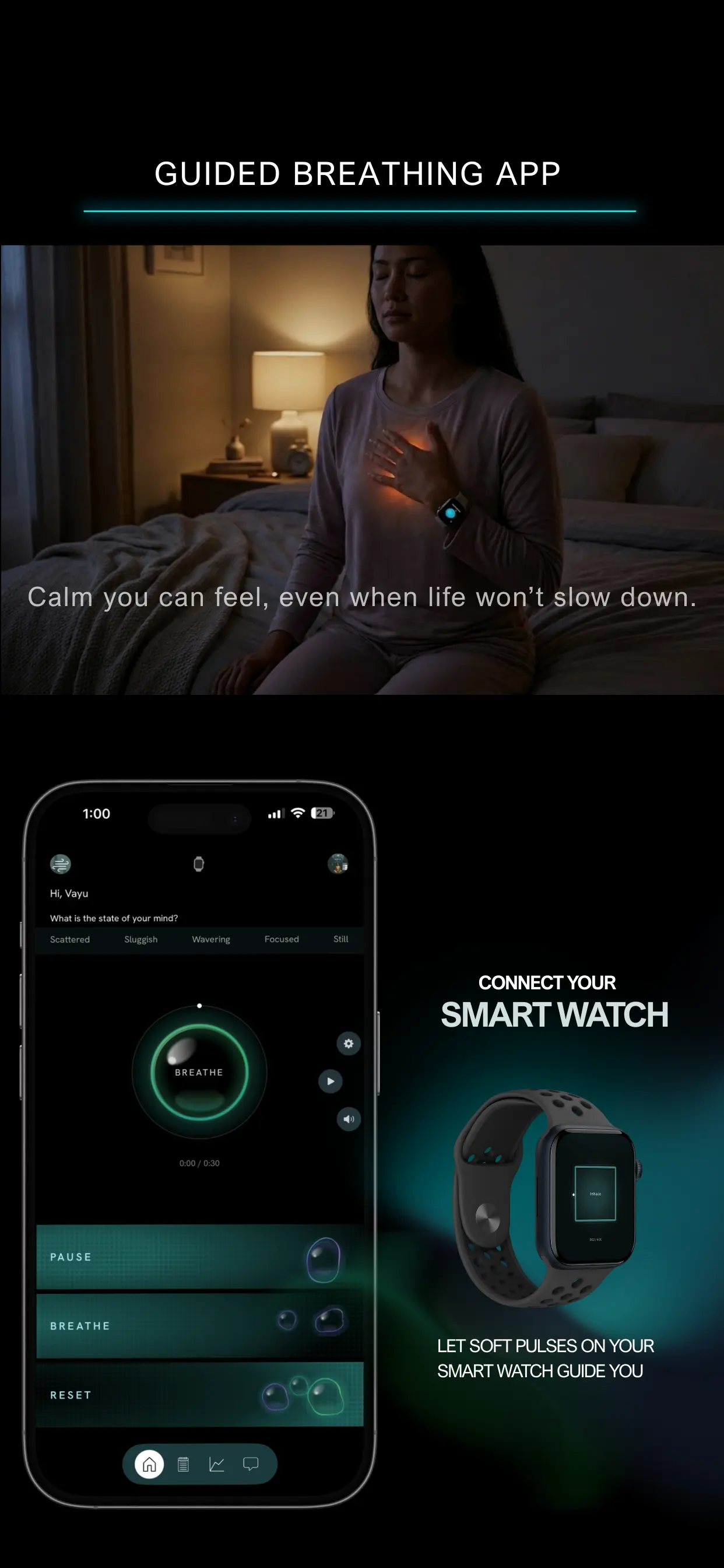
Where most breathwork apps invest in content libraries and guided audio, Vayu has invested in the technology layer: silent haptic pacing on the wrist, and Apple Watch HRV readings after each session that inform what the app recommends next.
HRV-Informed Pacing
Vayu reads your Apple Watch HRV after each session and shows how it compares with your recent sessions. Over days and weeks that record shows whether a given technique and pace is moving your numbers, and the app uses it to inform which session and pace it recommends next.
This addresses the biggest limitation of traditional breathwork apps: you're told to breathe a certain way, but you have no way of knowing whether it's actually affecting your physiology. A post-session HRV record makes that visible, one session at a time.
To be clear about what ships today: Vayu does not change your breathing pace mid-session based on HRV. A closed-loop controller has been designed and is described in the team's preprint, which is under peer review, but it is not in the app.
Dual Smartwatch Support
Vayu is currently the only breathwork app with full standalone apps for both Apple Watch and Wear OS. Breathwrk supports Apple Watch only. Othership has no wearable app. Calm and Headspace offer basic watch complications. Vayu itself runs on Apple Watch and Wear OS only; it does not pair with Garmin, Fitbit, Oura or Whoop devices.
The haptic breathing guidance is the real differentiator for wearable sessions. Your watch delivers distinct vibration patterns for inhale, hold, and exhale, guiding your breathing through touch alone. You can practise with your eyes closed, during a commute, or in bed without reaching for your phone. It's a qualitatively different experience from watching an animation.
Related: Best Apple Watch Breathing App | Best Wear OS Breathing App
Technique Library & Custom Patterns
Vayu ships with 10+ evidence-based techniques: box breathing, 4-7-8, physiological sigh, Wim Hof, Nadi Shodhana, Ujjayi, and more. But the custom pattern builder is what separates it from competitors: set your own inhale, hold, exhale, and post-exhale durations to create bespoke protocols.
This matters for anyone working with a therapist, coach, or specific clinical protocol that prescribes exact breathing ratios.
Where Vayu falls short
Vayu's primary investment is in breathwork technology rather than content volume. It does include meditation content, but the library is smaller than what Calm or Headspace offer. There are no sleep stories, no celebrity narrators, and no instructor-led emotional journeys. If you want a massive content library or immersive guided experiences, Calm, Headspace, or Othership will serve you better in those areas. Vayu's relative newness also means its overall content catalogue is still growing.
Best for: Data-driven practitioners, biohackers, Wear OS users, and anyone who wants measurable feedback from their breathwork practice.
Not ideal for: People seeking a broad wellness platform, sleep content, or emotionally immersive guided sessions.
Try Vayu free on iOS, Android, Apple Watch & Wear OS →
Free to download and try, with an optional Pro subscription.
Full Feature Comparison
| Feature | Calm | Headspace | Breathwrk | Othership | Oura | Garmin | Apple | Vayu |
|---|---|---|---|---|---|---|---|---|
| HRV feedback | ❌ | ❌ | ❌ | ❌ | Passive | ❌ | ❌ | Post-session |
| Haptic breathing guidance | ❌ | ❌ | ✅ | ❌ | ❌ | ✅ | ✅ | ✅ |
| Apple Watch app | Basic | Basic | ✅ | ❌ | ❌ | N/A | ✅ | ✅ |
| Wear OS app | ❌ | ❌ | ❌ | ❌ | ❌ | N/A | ❌ | ✅ |
| 10+ breathing techniques | ❌ | ❌ | ✅ | ✅ | ❌ | ❌ | ❌ | ✅ |
| Custom breathing patterns | ❌ | ❌ | ❌ | ❌ | ❌ | ❌ | ❌ | ✅ |
| Free core features | ❌ | ❌ | Limited | ❌ | ❌ | ✅* | ✅ | ✅ |
| Meditation / sleep content | ✅ | ✅ | ❌ | ❌ | ❌ | ❌ | ❌ | ✅ |
| Immersive guided journeys | ❌ | ❌ | ❌ | ✅ | ❌ | ❌ | ❌ | ❌ |
| 24/7 stress monitoring | ❌ | ❌ | ❌ | ❌ | ✅ | ✅ | ❌ | ❌ |
*Garmin breathwork requires a Garmin device. Vayu reads HRV from Apple Watch after each session; it does not adjust pacing mid-session.
Key Trends Shaping Breathwork Technology in 2026
1. The Biofeedback Standard
The biggest shift is the move from "follow the animation" to "see your body respond." HRV biofeedback was once limited to clinical settings with expensive hardware. Now it's available through consumer smartwatch sensors. This transforms breathwork from a subjective practice ("I feel calmer") into a measurable one ("My HRV increased 12ms during this session").
Expect biofeedback to become a baseline expectation for serious breathwork apps over the next 12–18 months.
2. Wearable-First Experiences
Phone-based breathing animations are giving way to wrist-based haptic guidance. The advantage is intuitive: you can practise breathwork with your eyes closed, during a meeting, on a walk, or in bed, guided entirely by vibration patterns. Most competitors still treat wearable apps as afterthoughts. The tools that invest in standalone smartwatch experiences are pulling ahead.
3. Technique Specificity
The "one breathing pattern fits all" era is over. The best breathwork technologies now offer specific techniques for specific outcomes:
- 4-7-8 breathing: falling asleep faster
- Box breathing (4-4-4-4): focus and calm under pressure
- Physiological sigh: immediate stress relief (backed by Stanford research)
- Wim Hof breathing: energy and cold tolerance
- Nadi Shodhana: nervous system balance
- Coherent breathing (5.5 breaths/minute): HRV optimisation
Apps offering only one or two patterns can't serve the full range of breathwork needs.
4. Health Data Integration
Breathwork technologies are connecting with Apple Health, Google Health Connect, and third-party wearables to create longitudinal data. The most powerful setup combines haptic guidance during sessions and HRV readings around them with passive 24/7 monitoring: in-session guidance plus long-term trend analysis.
How to Choose the Right Breathwork Technology
There's no single "best" tool; it depends on what you're optimising for:
- Broad wellness platform with some breathing: Calm or Headspace. You're paying for meditation, sleep stories, and focus content. Breathing is a bonus feature.
- Structured, goal-based breathwork programs: Breathwrk. Professional coaching, progressive programs, and a clean interface.
- Emotionally immersive breathwork journeys: Othership. Premium production quality and facilitated emotional arcs.
- Passive biometric tracking alongside breathwork: Oura Ring or Garmin. These measure what breathwork does to your body over time.
- Wearable haptics, HRV-informed pacing, and technique depth: Vayu. The only option here with both Apple Watch and Wear OS support, plus an HRV reading from Apple Watch after each session.
- Quick, no-setup breathing on Apple Watch: Apple Mindfulness. Already on your wrist.
- Wear OS smartwatch users: Vayu is the only app in this comparison with a full standalone Wear OS app.
The strongest setup for serious practitioners may be combining an active breathwork app (like Vayu or Breathwrk) with a passive biometric tracker (like Oura): in-session haptic guidance plus long-term physiological trend data.
Further Reading
- Best Breathing and Breathwork Apps: App-by-App Reviews
- Breathing Exercises for Anxiety
- Breathing Exercises for Sleep
- Breathing App for Stress Relief
- Breathing Techniques for Focus
Frequently Asked Questions
What is HRV biofeedback and why does it matter for breathwork?
HRV (heart rate variability) biofeedback measures the time variation between heartbeats during a breathing session. Higher HRV generally indicates stronger parasympathetic nervous system activation, the "rest and digest" response that breathwork aims to trigger. Tracking HRV around your sessions makes practice measurable rather than purely subjective. Vayu reads your Apple Watch HRV after each session and uses it to inform pacing recommendations; it does not adjust your pace mid-session.
What's the best breathwork technology for beginners?
For absolute beginners, Apple Mindfulness (free, pre-installed on Apple Watch) or Calm's breathing exercises provide the simplest starting point. For beginners who want to learn more techniques and understand their body's response, Vayu offers 10+ techniques with haptic watch guidance and a post-session HRV readout, without a learning curve. Breathwrk's goal-based approach is also beginner-friendly.
Can I use a smartwatch for breathwork?
Yes. Smartwatch-based breathwork uses haptic vibrations (distinct patterns for inhale, hold, and exhale) so you can practise with your eyes closed. Apple Watch has several breathwork apps available (Apple Mindfulness, Breathwrk, Vayu). For Wear OS smartwatches, Vayu is currently the only major option with a standalone app.
Is breathwork technology backed by science?
Yes. Research published in Cell Reports Medicine found that structured breathing exercises were more effective at reducing physiological stress markers than meditation alone. Specific techniques like the physiological sigh (Stanford, 2023), box breathing (used by Navy SEALs and studied in military contexts), and coherent breathing at 5.5 breaths per minute have robust evidence supporting their effects on the autonomic nervous system.
Do I need to pay for a breathwork app?
Not necessarily. Apple Mindfulness is free on Apple Watch (basic). Vayu is free to download and try, with guided sessions, multiple techniques, smartwatch support and post-session HRV, plus an optional Pro subscription. Paid apps like Calm ($69.99/year), Headspace ($69.99/year), Breathwrk ($59.99/year), and Othership ($14.99/month) offer additional content and features but aren't required to start an effective breathwork practice.
What's the difference between a breathwork app and a meditation app?
Meditation apps (Calm, Headspace) focus primarily on guided meditation, mindfulness, and sleep content; breathing exercises are a secondary feature. Dedicated breathwork apps (Vayu, Breathwrk, Othership) focus specifically on breathing techniques, often with more technique variety, customisation, wearable integration, and biofeedback. If your primary goal is breathwork, a dedicated tool will generally offer deeper functionality.
Practice These Techniques with Vayu
Haptic breathing guidance on Apple Watch and Wear OS, paced on your wrist so you do not need the screen. Developed with the SFU Metacreation Lab, supported by NRC IRAP. Your first session is free.
Continue Reading

Best Pranayama Apps for Apple Watch in 2026
Most breathing apps treat Apple Watch as an afterthought. These are the ones that actually use it well — with haptic guidance, HRV-informed sessions, and proper pranayama technique support.
Mar 5, 2026

Does HRV Biofeedback Work for Anxiety and Depression? What the Science Shows
Does HRV biofeedback work for anxiety and depression? Meta-analyses show small-to-medium effects on depression, but not stress. Here is the honest evidence.
Jul 12, 2026

Breathwork That Fits Real Life: Nervous System Tech and Conscious Computing with Dhruv Adhia
Vayu co-founder Dhruv Adhia joins the Bee Formless™ podcast to explore conscious computing, haptic-guided breathwork, and how technology can help us regulate our nervous systems. Learn about HRV science, box breathing, and Vayu's mission to touch a billion lives.
Jan 25, 2026